Vibratory Feeder for Bolts: Orientation, Tooling & Bowl Design Guide
Complete guide to vibratory feeders for bolts. Covers hex head orientation, cascade bowl design, center-post selectors, size sorting, and feed rate optimization for bolt feeding.
Key Challenges
Bolt Feeding Challenges in Automated Production
Bolts present unique feeding challenges that distinguish them from smaller fasteners like screws. Their larger mass requires more powerful vibration drives, their hexagonal heads demand precise orientation tooling, and their often oily surfaces from manufacturing create handling difficulties. In automotive and heavy equipment assembly, bolts are frequently fed at high rates into automated tightening stations, making reliable feeding a critical production requirement.
The primary challenge is achieving consistent hex-head orientation. Most automated bolt-driving systems require bolts to be delivered head-up with the thread pointing downward. The hex head geometry, while useful for tightening, creates six possible stable resting positions on a flat track surface, only one of which is correct. This requires multi-stage orientation tooling that progressively narrows the orientation possibilities until the bolt exits in the desired position.
Size sorting is another common requirement in bolt feeding. Production lines often handle multiple bolt lengths or diameters, and cross-contamination between sizes can cause assembly errors. Vibratory bowl feeders can incorporate mechanical gauging stations along the track that reject bolts outside the specified size range, ensuring only correctly sized fasteners reach the output.
Hex Head Orientation Techniques
Orienting hex-head bolts requires a combination of mechanical tooling and, in some cases, pneumatic assistance. The most effective approach uses a progressive orientation strategy with multiple tooling stages:
- Wiper blade stage — A curved wiper blade sweeps across the track, knocking over bolts that are standing upright or at steep angles. This ensures all bolts are lying flat on the track before entering the orientation zone.
- Head-width selector — A narrow gap or channel that allows the bolt shank (thread) to pass through but blocks the wider hex head. Bolts arriving head-first are rejected back into the bowl.
- Center-post orientor — A raised post or rail down the center of the track that fits between the hex head flats. Bolts riding head-up are stabilized by the center post, while incorrectly oriented bolts are destabilized and fall off the track.
- Air jet verification — A final air jet positioned at the exit blows any remaining incorrectly oriented bolts back into the bowl, providing a last-resort quality check.
Cascade Bowl Design for Bolts
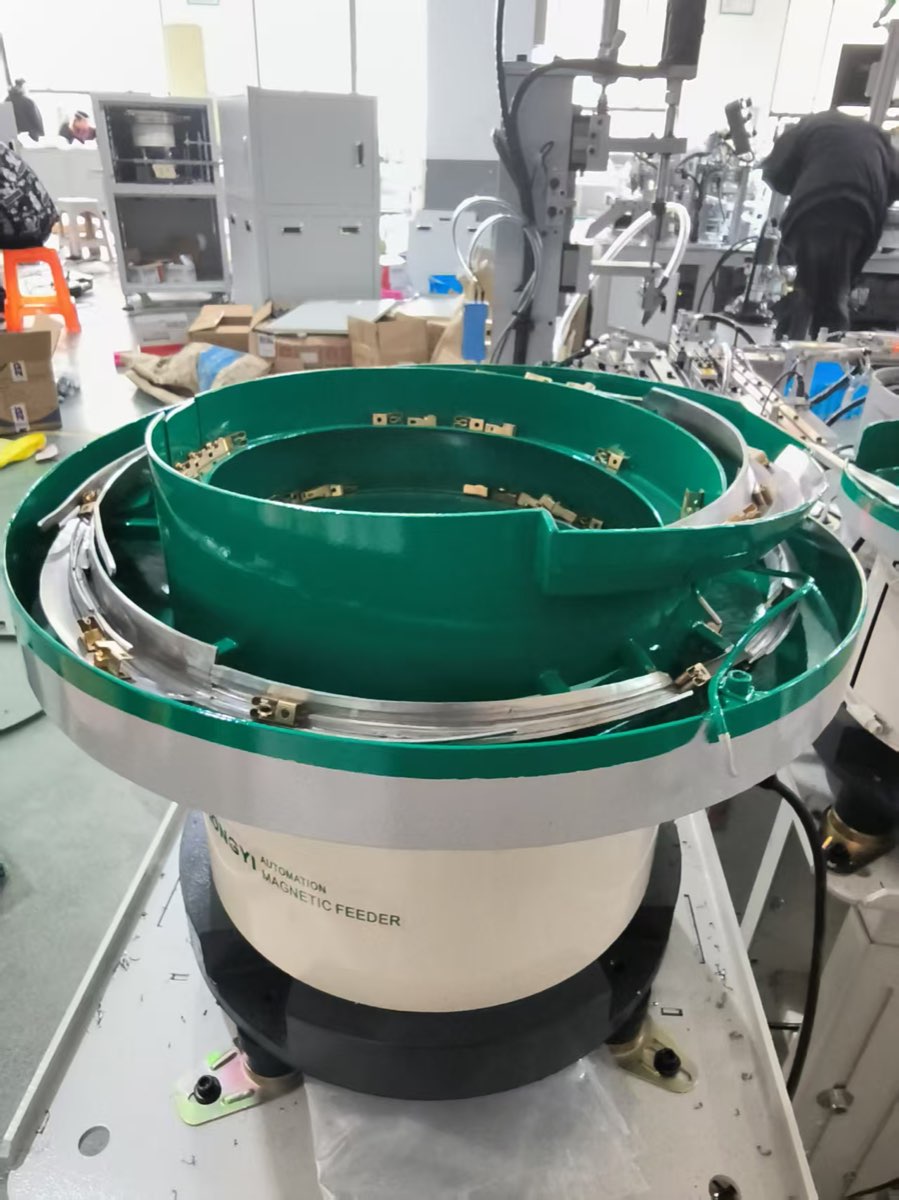
For bolts longer than 30mm or heavier than 15 grams, a cascade bowl design is often preferred over a standard spiral bowl. In a cascade bowl, the track descends in a series of stepped levels rather than a continuous spiral. This design offers several advantages for bolt feeding: the stepped transitions help separate tangled bolts, the shorter individual track sections reduce the vibration energy needed to move heavy bolts, and the multiple levels provide more tooling stations in a compact bowl diameter.
Cascade bowls are typically constructed from SUS304 stainless steel with a minimum wall thickness of 2mm to withstand the impact forces of heavy bolts. The step height between levels is usually 15–25mm, with each level providing 1–2 tooling stations. A 400mm cascade bowl with 4 levels can accommodate bolts up to 80mm long with feed rates of 40–80 ppm.
Center-Post Selectors for Bolt Orientation
The center-post selector is the most reliable tooling element for hex-head bolt orientation. It consists of a raised rail running down the center of the track at a height that fits between the flats of the hex head. When a bolt travels head-up along the track, the center post engages the hex head and guides it stably forward. When a bolt travels thread-first, the shank misses the center post and the bolt becomes unstable, falling off the track back into the bowl.
Center-post height and width must be precisely matched to the bolt hex size. For metric bolts, the across-flats dimension determines the center-post gap. The post height should be approximately 60–70% of the head height to provide adequate guidance without causing jams. Center-post selectors can achieve orientation accuracy of 99.5%+ for standard hex bolts when properly adjusted.
Size Sorting in Bolt Feeders
When a production line handles multiple bolt sizes, the feeder must either be dedicated to one size or incorporate sorting mechanisms. Mechanical sorting options include width gauges (narrow track sections that reject oversized bolts), length gauges (drop-through holes that catch short bolts while allowing correct-length bolts to pass), and air-blast sorters that use sensors to detect size and blow incorrect bolts off the track. For lines that frequently change bolt sizes, a flexible vibratory feeder with vision guidance may be more practical than a dedicated bowl with fixed tooling.
Bolt Feeder Specifications
| Bolt Size | Recommended Bowl | Feed Rate | Bowl Coating |
|---|---|---|---|
| M4–M6, 10–25mm | 300mm spiral | 60–120 ppm | PU |
| M6–M10, 20–50mm | 400mm cascade | 40–80 ppm | PU |
| M10–M16, 30–80mm | 500mm cascade | 20–60 ppm | PU or Teflon |
| M16–M24, 50–120mm | 600–800mm cascade | 10–30 ppm | Teflon |
Why Choose Huben for Bolt Feeding Systems
Huben Automation has delivered bolt feeding systems to automotive manufacturers across 30+ countries. Our cascade bowl designs are proven in high-volume production environments, and every system undergoes runoff testing with your actual bolts before shipping. With ISO 9001 certification and 20+ years of expertise, we guarantee performance at factory-direct prices that save you 40–60% compared to Western integrators.
Need a reliable bolt feeding system? Contact our engineering team for a free consultation and detailed quote.
Recommended Products
Ready to Automate Your Production?
Get a free consultation and detailed quote within 12 hours from our engineering team.