Vibratory Feeder for Terminals: Crimp-End Orientation & Nylon Bowl Guide
Practical guide to vibratory feeders for terminals. Covers crimp-end orientation, nylon bowl benefits, ESD considerations, and feed rate optimization for wire terminal feeding.

Key Challenges
Terminal Feeding Challenges in Wire Harness Manufacturing
Wire terminals are small, precision-stamped metal components used in wire harness and cable assembly. Their asymmetric geometry — with a crimp barrel on one end and a contact or tang on the other — requires consistent orientation for automated crimping and insertion processes. Most terminal feeding applications demand the terminal to be delivered crimp-end first, with the open barrel facing the crimping tool. Achieving this orientation reliably at speeds of 100–200 terminals per minute is the core challenge of terminal feeding.
Tin and gold plating on terminal contact surfaces must be preserved during feeding. Scratched or damaged plating increases contact resistance and can cause intermittent electrical connections in the final product. The thin plating layer (typically 1–5μm for tin, 0.1–0.8μm for gold) offers minimal protection against abrasion from hard tooling surfaces, making bowl material selection critical.
The small size of most terminals (3–15mm overall length) and their high production volumes make feed rate a key performance metric. Terminal feeding systems must balance orientation accuracy with throughput, as even brief feeding interruptions can starve downstream crimping machines and halt the entire wire processing line.
Orientation by Crimp-End Detection
Terminal orientation relies on the geometric difference between the crimp barrel end and the contact end. Several tooling approaches are used:
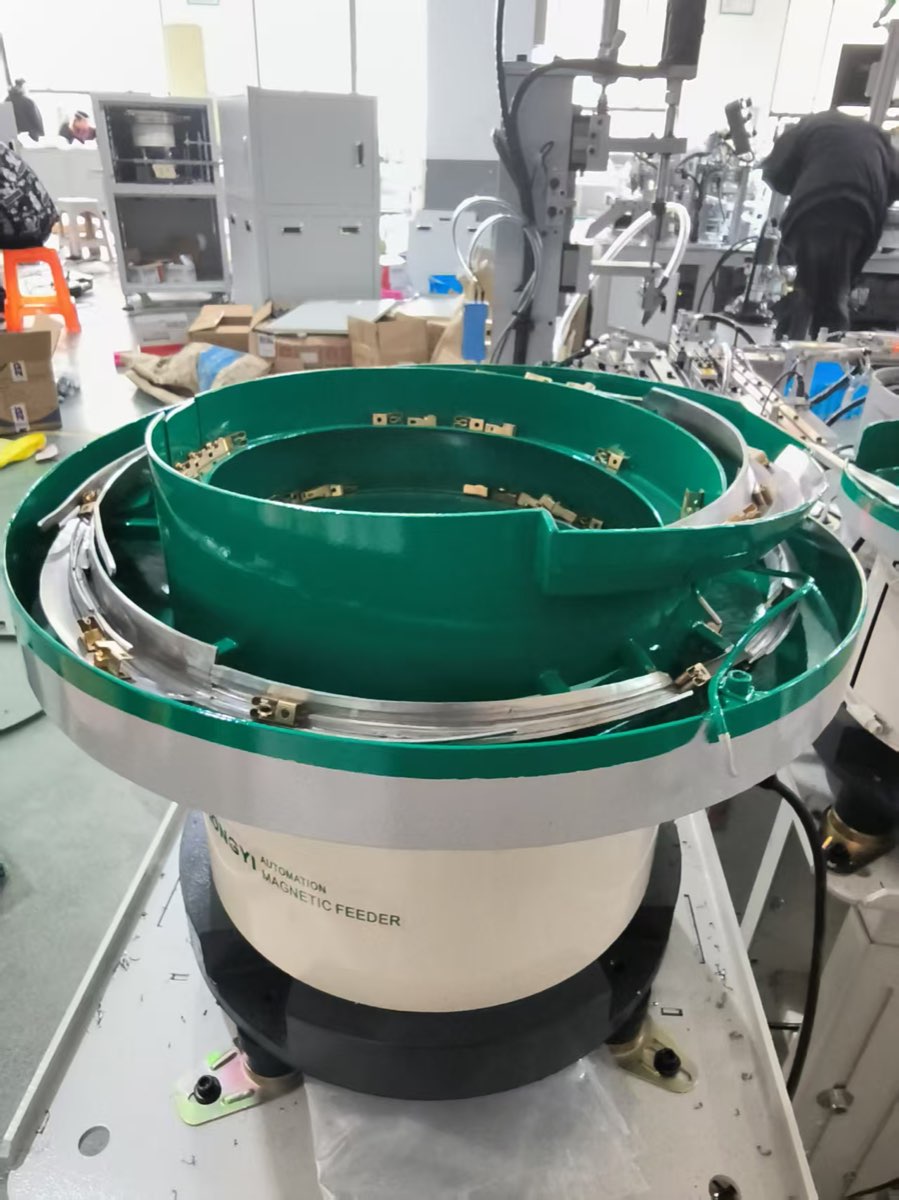
- Width selector — The crimp barrel is typically wider than the contact tang. A narrowing track section allows the narrow contact end to pass while the wider crimp end is caught and redirected. This is the simplest and most reliable method for terminals with significant width differential.
- Height selector — Open-barrel terminals have a taller profile at the crimp end due to the folded barrel wings. A height-restricting baffle allows the low-profile contact end to pass underneath while blocking the taller crimp end, which is then redirected into the correct orientation.
- Weight-bias orientation — Some terminals are heavier at the crimp end due to the additional barrel material. A tilted track section exploits this weight bias, causing the terminal to slide crimp-end downward. This method is less precise and is typically used as a pre-orientation stage before a mechanical selector.
- Vision verification — For terminals with subtle geometric differences, a vision system at the output verifies correct orientation and triggers rejection of incorrectly oriented parts. This adds cost but provides the highest orientation accuracy.
Nylon Bowl Benefits for Terminal Feeding
Nylon (polyamide) bowls offer several specific advantages for terminal feeding that make them the preferred choice over stainless steel or aluminum:
- Plating protection — The soft, non-metallic surface prevents scratching of tin and gold plating during feeding. Terminals sliding along a nylon track experience minimal abrasive contact, preserving contact surface quality.
- ESD safety — Conductive-grade nylon (nylon with carbon fiber or carbon black filler) provides controlled static dissipation with surface resistivity in the 10⁶–10⁹ ohm/sq range. This prevents static charge accumulation while avoiding the rapid discharge that can damage sensitive components.
- Lightweight — Nylon bowls weigh 40–60% less than equivalent stainless steel bowls, reducing the moving mass and allowing lower vibration amplitudes for the same feed rate. This translates to gentler part handling and lower energy consumption.
- Noise reduction — The inherent damping properties of nylon reduce impact noise from metal terminals by 8–12 dB(A) compared to bare stainless steel bowls, creating a more comfortable working environment.
ESD Considerations for Terminal Feeders
Terminals destined for automotive, aerospace, and medical electronics applications often have strict ESD requirements. The feeder system must address several ESD concerns:
- Static generation from vibration — The continuous vibration and part movement generates triboelectric charges. Conductive nylon or grounded stainless steel bowls with ionizing air bars are recommended for ESD-sensitive terminals.
- Charge accumulation on non-conductive surfaces — Any non-conductive components in the feeder (insulating track sections, plastic tooling elements) must be replaced with conductive alternatives or treated with anti-static coatings.
- Operator safety — The feeder must be grounded to the same potential as the production line to prevent discharge through operators or downstream equipment. Grounding cables with <1 megohm resistance should connect all feeder components.
Terminal Feeder Specifications
| Terminal Type | Size Range | Recommended Bowl | Feed Rate |
|---|---|---|---|
| Ring terminals | 8–15mm | 130–200mm nylon | 80–150 ppm |
| Spade terminals | 6–12mm | 130–200mm nylon | 100–180 ppm |
| Open-barrel terminals | 3–10mm | 130–200mm conductive nylon | 120–200 ppm |
| Closed-barrel terminals | 5–15mm | 150–250mm nylon | 80–150 ppm |
| PCB terminals | 5–12mm | 150–250mm conductive nylon | 60–120 ppm |
Why Choose Huben for Terminal Feeding Systems
Huben Automation supplies terminal feeding systems to wire harness manufacturers across automotive, appliance, and electronics industries worldwide. Our nylon bowl designs are optimized for plating protection and ESD safety, and every feeder undergoes runoff testing with your actual terminals to verify orientation accuracy and zero plating damage. With 20+ years of experience, ISO 9001 certification, and factory-direct pricing that saves 40–60%, Huben delivers proven terminal feeding solutions.
Need a high-speed terminal feeding system? Contact our engineering team for a free consultation and nylon bowl recommendation.
Recommended Products
Ready to Automate Your Production?
Get a free consultation and detailed quote within 12 hours from our engineering team.