Vibratory Feeder Capacity Calculation Guide 2026

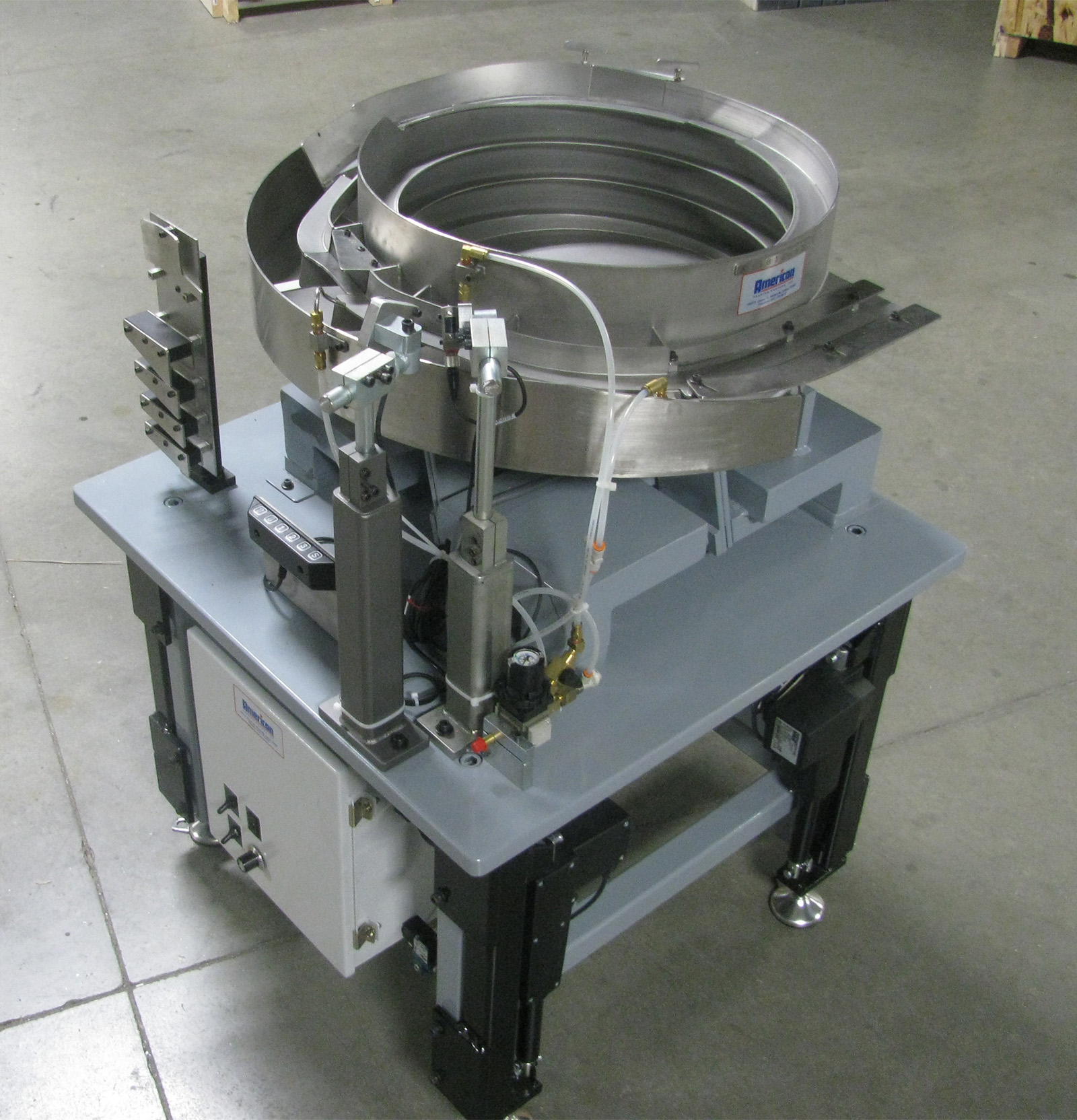
Capacity is more than parts per minute
When buyers ask for feeder capacity, they usually want one number: parts per minute. That number matters, but by itself it can be misleading. A bowl feeder that reaches 220 parts per minute for thirty seconds on a half-filled bowl is not a 220 ppm production system if it settles at 165 ppm once the line runs continuously. Real capacity is the output you can hold at the required orientation rate, with the normal fill level, under the actual downstream demand.
That is why capacity calculation should start with the process, not the machine catalog. You need to know how the downstream station consumes parts, how much buffer the line needs, what orientation yield is acceptable, and how much margin you want when product lots vary slightly. Without those inputs, the math looks precise but the purchased feeder still ends up undersized.
This guide gives a practical way to size a vibratory feeder around real production conditions. We will define the input variables, show a simple calculation model, compare common feeder-type output ranges, and explain why fill level and orientation losses matter so much. If you are still deciding between equipment types, see our comparisons of step feeder vs vibratory feeder and linear feeder vs bowl feeder.
Start with the target line demand
The cleanest place to start is the downstream machine. If the assembly station consumes one part every 0.40 seconds, the minimum demand is 150 parts per minute. But that is only the base number. You still need to account for line efficiency, micro-stops, reject losses, and the fact that a feeder should not be sized with zero margin.
A simple planning formula works well for most projects:
Required feeder output = downstream demand / orientation yield x safety factor
For example, if the station needs 150 ppm, the bowl-tooling package is expected to achieve 98% correct orientation at the discharge, and you want 10% margin, the target becomes:
150 / 0.98 x 1.10 = 168.4 ppm
Round that up. In this case, you would not buy a 170 ppm system and hope for the best. You would ask the supplier to prove stable output around 175-180 ppm under a realistic bowl load. That extra room is what keeps the line calm when parts vary slightly from lot to lot.
- Demand rate: the actual sustained requirement from the next machine.
- Orientation yield: percentage of parts leaving the feeder correctly oriented.
- Safety factor: margin for normal production drift, often 1.05 to 1.20 depending on the line risk.
- Buffer expectation: how much short-term storage the feeder and track must provide during machine cycling.
Skipping any of those makes the capacity estimate look cleaner than reality. Reality still wins.
The five inputs that matter most
Some feeder quotes include little more than part size and target ppm. That is rarely enough. The variables below usually decide whether a project lands in the safe zone or comes back for rework.
- Part geometry. Long parts, flat parts, interlocking shapes, and parts with high center of gravity all reduce practical throughput compared with simple cylindrical parts.
- Part weight. Heavier parts need more drive energy and often lower the useful track angle or capacity of a given bowl diameter.
- Surface condition. Oil, plating, burrs, and cosmetic finish requirements all affect friction and orientation reliability.
- Fill level. Many bowls are happiest at one-third to one-half full. Overfilling can reduce feed rate and increase recirculation losses.
- Tooling complexity. Every selector, wiper, escape, and return point removes some of the raw motion created by the drive.
That last point is the one most often underestimated. The drive may be strong enough, but the tooling is what decides how much of that motion turns into usable throughput. A bowl feeding identical short screws may hold 200+ ppm on a compact platform, while a bowl presenting delicate asymmetrical molded parts may need a larger diameter and calmer motion to achieve half that number with acceptable orientation quality.
| Input | If it gets worse | Capacity effect | Typical response |
|---|---|---|---|
| Part complexity | More orientations to reject | Throughput falls | Larger bowl, calmer rate, more tooling development |
| Part weight | Higher moving mass | Drive load rises | Review spring pack and bowl diameter |
| Oil or low friction | Slip on the track | Parts fall back | Adjust coating, angle, or track geometry |
| High fill level | More recirculation and drag | Loaded output drops | Control refill point and test at full load |
| Tight orientation spec | More reject actions | Net discharge lowers | Build margin into the target ppm |
A calculation model you can use before sampling
Before formal runoff testing, a simple model helps narrow the machine size. Start with the target good-part output, then back-calculate the gross movement required in the bowl.
- Set good-part demand. Example: 180 good parts per minute at the discharge.
- Estimate orientation yield. Use a conservative value. If the part is tricky, do not assume 99.5% from day one. Example: 95%.
- Add operating margin. Example: 10%.
- Correct for fill-level loss. If prior experience or testing shows full-bowl output drops 8% from the half-load state, include it.
That gives:
Gross bowl movement target = 180 / 0.95 x 1.10 / 0.92 = 227.4 ppm equivalent
Now you have a more honest design target. A supplier who promises 180 ppm without asking about yield loss or fill-level drop may still be describing the same machine, but they are describing its best moment, not its normal job.
If you already have a feeder in house, test at 50% and 100% bowl fill and record actual results. Many systems show less than 5% drop when well matched. Once the drop goes beyond roughly 10%, you should look at bowl fill practice, spring tuning, controller reserve, or the possibility that the system is simply undersized for the part and tooling package.
Know the normal output range by feeder type
Capacity calculations also depend on whether a bowl feeder is even the right platform. Buyers sometimes try to force one technology into a range where another would be simpler or more stable.
| Feeder type | Typical output range | Best fit | Watch-outs |
|---|---|---|---|
| Step feeder | About 20-200 ppm | Noisy or tangled small parts, quieter operation | Usually lower top speed than a tuned bowl feeder |
| Vibratory bowl feeder | About 200-1000+ ppm depending on part and tooling | Wide range of small-to-medium parts with orientation needs | Throughput depends heavily on tooling and tuning |
| Centrifugal feeder | About 1000-3000+ ppm for suitable parts | Very high speed, simple stable part geometries | Less forgiving for complex orientation tasks |
| Linear feeder | Transfer stage, not bulk orientation source | Buffering and controlled presentation from a bowl | Should not be mistaken for the main bulk capacity source |
That table is not a guarantee. It is a planning guide. If a supplier claims a rate far outside the normal band, ask how they achieved it and under what test condition.
Worked example: sizing a feeder for a 160 ppm assembly line
Imagine a line assembling a small stamped clip at 160 ppm. The clip has two stable wrong orientations, slight oil film from upstream pressing, and a cosmetic requirement that rules out aggressive track surfaces.
- Downstream demand: 160 ppm.
- Estimated orientation yield: 96% after initial tooling.
- Safety factor: 1.10 because the line is sensitive to starvation.
- Loaded-bowl correction: 0.94 based on similar feeders already running in the plant.
The design target becomes 160 / 0.96 x 1.10 / 0.94 = 194.9 ppm. So the feeder should be specified and tested closer to 195-200 ppm net capability, not merely 160 ppm. From there, the engineering choice might be a medium-size vibratory bowl feeder with a friction-controlled surface treatment and conservative track geometry, rather than a smaller bowl pushed to the edge of its drive range.
That answer may raise the initial price slightly, but it usually lowers total cost. An undersized feeder often looks cheaper until production starts. Then it asks for constant refill attention, repeated retuning, or tooling changes that cost more than the original savings. If budget is part of the decision, compare the numbers against our vibratory bowl feeder price guide and feeding system TCO guide.
The last checks before you approve a supplier
Once the capacity model is built, use it to challenge the proposal. Ask the supplier what bowl fill level they used, what orientation yield they assumed, and whether their runoff target represents gross movement or good-part output at the discharge. Those are not small details. They are the whole argument.
- Ask for a runoff condition: part sample, fill level, duration, and accepted output variation.
- Separate gross movement from good output: the latter is what the line actually uses.
- Check controller reserve: a feeder sized correctly should not need to live at full output.
- Test with production parts: prototype samples that differ in finish or burr condition can distort the result.
Huben Automation sizes feeders around real line demand, not optimistic brochure numbers. If you want help turning your target cycle time into a realistic feeder capacity spec, send us your part drawing or sample and we can review bowl size, tooling strategy, and expected output margin before the project goes to build.
Ready to Automate Your Production?
Get a free consultation and detailed quote within 12 hours from our engineering team.