Vibratory Bowl Feeders for Fasteners from China: Sourcing Guide

Introduction: The Critical Role of Fastener Feeding
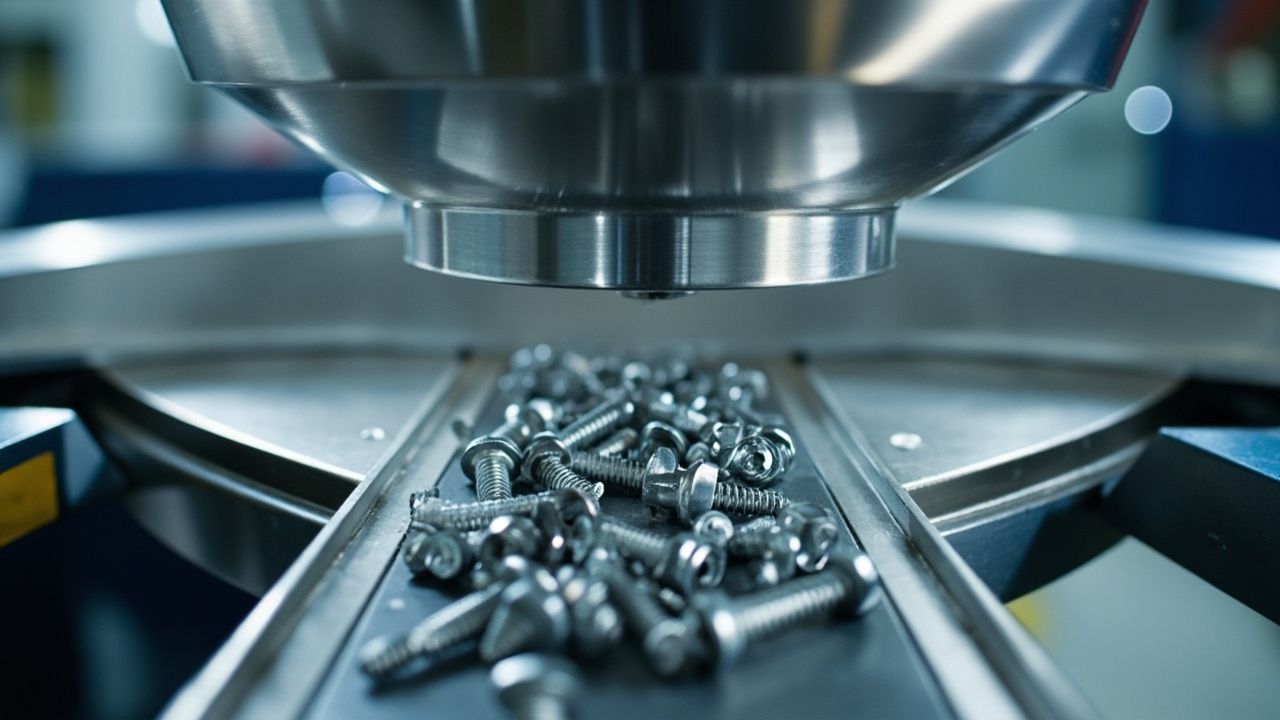
Fasteners, screws, nuts, bolts, and rivets are among the most commonly fed components in automated manufacturing. Every assembled product from smartphones to automobiles relies on threaded fasteners, and automating their delivery to assembly stations is essential for production efficiency. Vibratory bowl feeders have proven to be the most reliable and cost-effective solution for fastener feeding across virtually all manufacturing sectors.
China manufactures a substantial portion of the world's vibratory bowl feeders, with particular expertise in fastener feeding applications due to the country's massive automotive, electronics, and appliance industries. This guide addresses the specific considerations for sourcing vibratory bowl feeders for fasteners from Chinese manufacturers, covering common fastener types, tooling design requirements, feed rate optimization, and supplier selection criteria tailored to fastener applications.
Common Fastener Types and Feeding Challenges
Different fastener types present unique feeding challenges that influence bowl design, tooling configuration, and system specification.
Machine Screws and Self-Tapping Screws
Machine screws with consistent diameters and thread profiles feed reliably in vibratory bowls. The primary orientation challenge is ensuring all screws exit with the head leading and the threaded end trailing. Head type significantly affects tooling design. Pan head, flat head, and round head screws each require different selector configurations. Self-tapping screws with sharp points require track designs that prevent point engagement with the bowl surface, which can cause jamming or part damage.
Hex Head Bolts and Cap Screws
Hex head fasteners orient naturally due to their asymmetric head geometry. The six-sided head creates a distinct center of gravity that favors head-up or head-down orientation depending on track angle. Larger bolts require proportionally larger bowls with heavier drive units to maintain proper vibration amplitude under increased load. The main challenge with hex bolts is preventing shingling, where bolts stack on top of each other and jam the tooling.
Nuts and Hex Nuts
Nuts present interesting orientation challenges because their symmetrical geometry lacks a natural preferred orientation. Through-hole nuts must be oriented with the threaded bore vertical for robotic picking or horizontal for escapement delivery. Flanged nuts offer slightly better orientation characteristics due to the flange asymmetry. Very small nuts, particularly M3 and smaller, require precise track tolerances to prevent jamming in selectors.
Rivets and Pins
Solid rivets and dowel pins are cylindrical with minimal orientation features, making them among the more challenging fastener types to feed. Headed rivets orient similarly to screws but with less pronounced center of gravity difference. Blind rivets with mandrels require tooling that accounts for the mandrel protrusion and prevents mandrel entanglement. Taper pins and roll pins present additional complexity due to their variable diameter.
Washers and Spacers
Flat washers feed well in vibratory bowls due to their disc geometry, which naturally orients them flat against the track. The challenge is preventing stacking, where multiple washers adhere to each other through surface tension or oil films. Spring lock washers and wave washers require track designs that accommodate their non-flat profiles without causing jamming.
| Fastener Type | Size Range | Orientation Challenge | Typical Feed Rate | Tooling Complexity |
|---|---|---|---|---|
| Machine Screws | M2 - M8 | Head-leading orientation | 60-300 ppm | Medium |
| Self-Tapping Screws | ST2.2 - ST6.3 | Point protection, thread engagement | 50-250 ppm | Medium-High |
| Hex Head Bolts | M3 - M12 | Shingling prevention | 40-200 ppm | Medium |
| Hex Nuts | M2.5 - M10 | Through-hole orientation | 80-400 ppm | Medium |
| Blind Rivets | 2.4 - 6.4 mm | Mandrel handling | 40-150 ppm | High |
| Flat Washers | M3 - M12 | Stacking prevention | 100-500 ppm | Low-Medium |
| Spring Washers | M3 - M10 | Profile accommodation | 60-250 ppm | Medium |
| Threaded Inserts | M2 - M8 | External feature orientation | 50-200 ppm | High |
Tooling Design for Fastener Applications
Effective fastener feeding depends critically on proper tooling design. Chinese manufacturers with fastener expertise understand the nuances of fastener geometry and design tooling accordingly.
Track Geometry and Surface Treatment
Fastener tracks require precise width tolerances, typically part width plus 0.3-0.8 mm depending on part size and required orientation precision. For threaded fasteners, track surfaces must be hardened or coated to resist thread abrasion. Polyurethane coatings protect both the track and fastener threads while reducing noise. For oily fasteners, oil-resistant coatings prevent surface degradation.
Orientation Selectors
Selector design varies by fastener type. Width selectors separate screws by head diameter, allowing only properly oriented parts to pass. Height selectors use cutouts that drop out parts exceeding a specific height profile. Air jets can blow off incorrectly oriented lightweight parts or assist in flipping parts to the correct orientation. Cascade selectors use multiple sequential selection stages for complex orientation requirements.
Escapement and Delivery Mechanisms
The escapement presents oriented fasteners to the downstream process, whether a robotic pick station, automatic screwdriver, or assembly machine. Pneumatic escapements use air cylinders to release one part at a time with precise timing. Mechanical escapements use cam-driven fingers for high-speed release. Servo-driven escapements offer programmable release patterns for complex assembly sequences.
Feed Rate Optimization Strategies
Achieving and maintaining specified feed rates requires attention to multiple system parameters and operating conditions.
Vibration Amplitude and Frequency
Fastener feed rate is directly related to vibration amplitude, but excessive amplitude causes part damage and excessive noise. The optimal amplitude depends on fastener weight, surface finish, and bowl coating. Modern digital controllers allow precise amplitude adjustment and frequency tuning to match the fastener's natural movement characteristics. Frequency adjustment between 50-100 Hz can significantly improve feeding performance for specific fastener types.
Bowl Loading and Hopper Management
Consistent bowl loading maintains stable feed rates. Too few parts in the bowl reduce feed rate and cause erratic delivery. Too many parts overload the drive unit and reduce amplitude. Automatic hopper elevators with level sensors maintain optimal bowl loading by replenishing parts when the level drops below a setpoint. Hopper capacity should support at least 30 minutes of unattended operation.
Part Quality and Consistency
Fastener dimensional variation significantly affects feeding performance. Thread diameter variation of more than 0.1 mm can cause jamming in precision selectors. Head diameter variation affects width selector performance. Bent or damaged fasteners inevitably jam the tooling and should be filtered at the source. Specify fastener quality grade and tolerance when designing feeding systems.
Supplier Selection for Fastener Feeders
Not all vibratory feeder manufacturers have equal expertise in fastener applications. Evaluating suppliers specifically for fastener feeding capability ensures better outcomes.
Fastener Application Experience
Request case studies or references specifically for fastener feeding applications. Manufacturers with extensive fastener experience understand common pitfalls and design proven solutions. Ask about the range of fastener types they have successfully fed, including the smallest and largest sizes. Experience with your specific fastener type, whether micro-screws for electronics or large bolts for construction equipment, is particularly valuable.
Tooling Design Capability
Fastener feeding demands precise tooling design. Evaluate the supplier's engineering team capability through their design process documentation. Quality suppliers perform part analysis including center of gravity calculation, orientation probability assessment, and tooling simulation before fabrication. Request sample tooling drawings for evaluation of design detail and tolerancing.
Testing and Validation Process
Reputable manufacturers test feeders with your actual production fasteners before shipment, not just similar parts. The testing protocol should measure feed rate consistency, orientation accuracy, jam frequency, and part damage rate over extended runs. Request video documentation of testing with your specific fasteners. Performance guarantees should specify acceptable feed rate variation and orientation yield.
After-Sales Support for Fastener Applications
Fastener feeding issues often require application-specific troubleshooting. Ensure your supplier offers remote diagnostic support and can provide spare tooling components. Tooling wear is normal in fastener applications due to abrasive thread contact; confirm spare tooling availability and lead times. Huben Automation maintains tooling records for all customer applications, enabling rapid spare part reproduction.
Integration with Automatic Screwdrivers and Assembly
Vibratory bowl feeders for fasteners rarely operate in isolation. Successful integration with automatic screwdrivers, nut runners, and robotic assembly systems requires careful interface design.
Automatic Screwdriver Interface
Automatic screwdrivers require fasteners presented at precise positions and orientations. The feeder escapement must align with the screwdriver pickup mechanism, whether vacuum-based, magnetic, or mechanical jaw. Timing synchronization between feeder release and screwdriver cycle is critical; missed pickups cause downtime and potential damage. Buffer stations between feeder and screwdriver can absorb minor timing variations.
Robotic Pick Integration
When robots pick fasteners from the feeder, the presentation position must be repeatable within the robot's positioning tolerance, typically plus or minus 0.2-0.5 mm. Vision systems can compensate for minor position variation but add cycle time and cost. The feeder should include part-present sensors to signal the robot when a fastener is ready for pickup.
Multi-Fastener Assembly Lines
Complex assemblies requiring multiple fastener types need either multiple dedicated feeders or quick-change tooling systems. Dedicated feeders offer highest uptime but require more floor space and capital investment. Quick-change systems with interchangeable tooling and bowl inserts reduce changeover time to 15-30 minutes, suitable for batch production environments.
Quality Standards for Fastener Feeding Systems
Fastener feeding systems must meet quality standards appropriate to their application industry.
Automotive Industry Requirements
Automotive fastener feeding systems typically require PPAP documentation, including dimensional inspection, performance testing, and process capability studies. Feed rate consistency must demonstrate Cpk values above 1.33. Traceability requirements may mandate serialization of feeder tooling for change control. IATF 16949 certification of the feeder manufacturer supports automotive customer requirements.
Electronics Industry Requirements
Electronics manufacturing demands ESD protection for metal fasteners that could damage sensitive components. Feeders must use static-dissipative materials or grounding systems. Clean operation without particulate generation is essential for cleanroom environments. Small fastener feeding for electronics requires precision that challenges even experienced manufacturers.
General Industrial Requirements
For general industrial applications, ISO 9001 certification of the feeder manufacturer provides reasonable quality assurance. Performance specifications should include guaranteed feed rate, orientation accuracy, and mean time between failures. Warranty terms of 12 months are standard, with extended warranties available for critical applications.
Frequently Asked Questions
What information do I need to provide for a fastener feeder quotation?
Provide physical samples of your fasteners including dimensional drawings if available. Specify the required feed rate in parts per minute, desired orientation at discharge, downstream equipment interface, and operating environment conditions. Include annual volume forecasts and any changeover requirements. If you have existing feeding issues, describe the symptoms and current system configuration. The more complete your information, the more accurate the quotation and system design.
Can one bowl feeder handle multiple fastener sizes?
Standard bowl feeders with fixed tooling cannot handle multiple fastener sizes effectively. Some size variation within the same fastener family can be accommodated with adjustable selectors, typically plus or minus 15-20% of nominal dimensions. For significantly different fasteners, quick-change tooling systems or multiple bowl feeders are required. Flexible feeders can handle multiple fastener types without mechanical changeover but at lower feed rates and higher cost.
How do I prevent thread damage during vibratory feeding?
Several design strategies protect fastener threads. Polyurethane or urethane bowl coatings cushion part-to-bowl contact. Controlled vibration amplitude prevents excessive part-to-part impact. Proper bowl loading avoids overcrowding that causes part entanglement. Track designs with smooth radiused transitions prevent thread engagement with sharp edges. For critical applications, centrifugal or step feeders provide gentler handling than vibration.
What feed rates are achievable for small screws in vibratory bowls?
Small screws from M1.6 to M3 typically achieve feed rates of 60-200 parts per minute depending on length and head type. Very small screws below M1.6 may achieve 40-100 ppm due to handling challenges. Feed rates increase with screw size up to M6-M8, where rates of 200-400 ppm are common. These rates assume proper bowl design, optimal vibration settings, and consistent part quality.
How do Chinese fastener feeder prices compare to Western suppliers?
Chinese manufacturers typically offer fastener feeders at 40-60% lower prices than Western suppliers for equivalent specifications. A standard screw feeder from a Chinese factory-direct manufacturer costs $1,000-2,500, while Western suppliers charge $2,500-6,000. Custom fastener feeders show similar proportional savings. The price difference reflects lower manufacturing overhead and labor costs, not necessarily lower quality, as established Chinese manufacturers use comparable materials and engineering methods.
What is the typical lead time for a custom fastener feeder from China?
Standard fastener feeders ship within 15-25 days. Custom-tooled feeders for specific fasteners require 30-45 days including tooling design, fabrication, and testing. Complex multi-stage tooling or integration with downstream equipment extends lead times to 45-60 days. Rush orders can sometimes be accommodated with expedited engineering and overtime production for 15-20% surcharge. View our pricing guide for cost considerations.
Conclusion: Sourcing Fastener Feeders with Confidence
Vibratory bowl feeders remain the dominant solution for automated fastener feeding across manufacturing industries worldwide. China's established manufacturing base offers fastener feeders with quality comparable to Western suppliers at significantly lower prices, making automation accessible to a broader range of manufacturers.
Successful fastener feeder sourcing requires understanding the specific challenges your fastener type presents, evaluating suppliers for relevant application experience, and ensuring proper integration with your downstream assembly processes. The investment in thorough specification and supplier qualification pays dividends in reliable long-term operation.
Fastener feeding applications demand expertise that comes from focused experience. Huben Automation has designed and manufactured fastener feeders for automotive, electronics, appliance, and general industrial customers across more than 200 successful projects. Our engineering team understands the nuances of screw, bolt, nut, and rivet feeding and designs tooling optimized for each specific fastener geometry.
Ready to automate your fastener feeding process? Contact Huben Engineering Team with your fastener samples and production requirements. We provide free feasibility analysis, detailed quotations, and performance-guaranteed feeding solutions tailored to your application.
Ready to Automate Your Production?
Get a free consultation and detailed quote within 12 hours from our engineering team.