O-Ring Feeding System Guide 2026

Why O-rings are harder to feed than they look
O-ring feeding projects often look easy at RFQ stage because the part is small, symmetrical, and inexpensive. On the machine, the trouble starts fast. Elastomer parts cling together, roll unpredictably, flatten under load, and change behavior with oil, powder, or room humidity.
That is why an O-ring feeding system should be designed around separation and consistency, not just raw vibration. If the bowl surface is wrong, parts skid and bunch up. If the tooling is too aggressive, the ring deforms and the orientation point loses repeatability. The problem is not dramatic. It is just constant.
This guide focuses on the practical choices that usually decide whether an O-ring feeder becomes a stable production tool or a maintenance headache. If your line already struggles with soft materials, compare this with our rubber parts feeding guide and coating guide.
What makes O-ring feeding unstable
O-rings do not simply slide up a track the way metal fasteners do. They roll, wobble, and sometimes travel as pairs because static or surface tack keeps them together. Once that happens, the track may still move parts, but the discharge becomes unreliable.
Compression set is another issue. When the bowl is overloaded, lower layers of rings sit under weight and can briefly change shape. That affects how they sit in pockets or against guide rails. The result can look like random misfeeds even though the real cause is just poor bulk handling.
Material matters too. NBR, silicone, EPDM, and fluorocarbon rings do not behave the same. One may need more grip. Another may need less contact pressure. If the supplier quotes one feeder concept for every elastomer, ask more questions.
| Condition | Typical symptom | Common cause | Useful response |
|---|---|---|---|
| Dry light O-rings | Parts travel in pairs | Static and low mass | Use anti-static handling and calmer motion |
| Oily O-rings | Poor separation at entry | Surface tack and drag | Open the entry section and review coating choice |
| Large soft rings | Distorted orientation | Compression under bowl load | Lower fill level and reduce contact pressure |
| Tight tolerance rings | Random rejects | Pocket or rail geometry too aggressive | Rework tooling around actual production samples |
Bowl feeder, flexible feeder, or pocketed track?
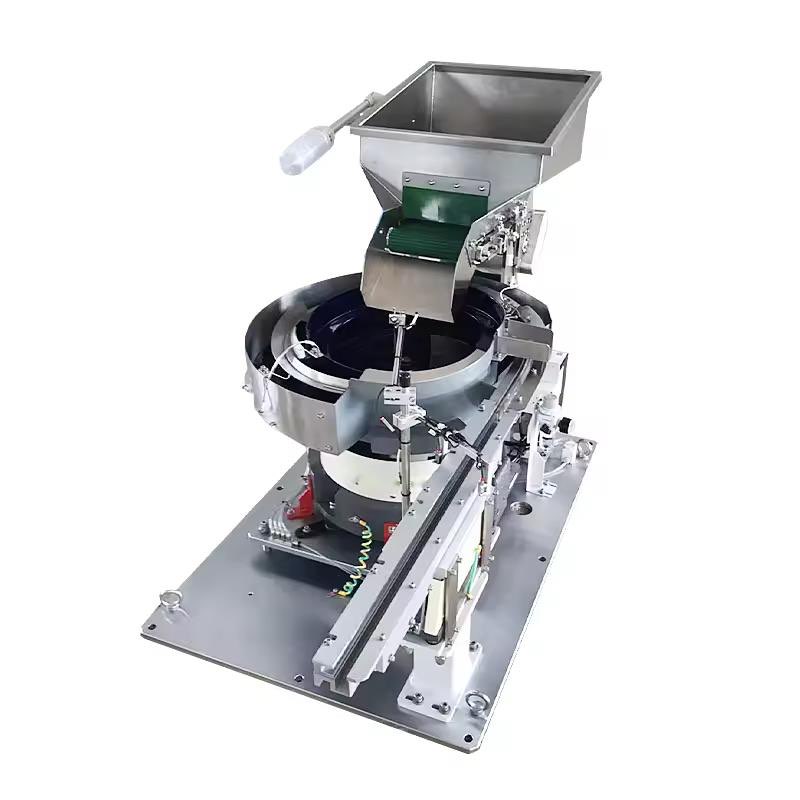
A standard bowl feeder still works well for single O-ring sizes running at stable volume. The bowl usually needs a softer contact strategy than a metal-parts feeder, and the tooling should favor gentle separation over sharp rejection features.
Flexible feeders become more attractive when the line changes among several O-ring diameters or materials. They run slower, but they reduce the amount of fixed mechanical tooling and can handle recipe changes more cleanly. That trade-off often pays back on mixed-model assembly lines.
If your line needs bulk storage and longer unattended runtime, review hopper behavior carefully. A large hopper helps only if it refills the bowl without flooding it. Our hopper elevator sizing guide explains how to keep the bowl in its stable operating window.
Design rules that usually improve O-ring feeding
Most O-ring systems improve when engineers simplify the contact pattern and control bulk pressure better. The following rules are a good starting point.
- Keep bowl fill modest. Most O-ring feeders behave better when the bowl is kept in a narrow range instead of being packed full.
- Use softer contact surfaces. Nylon bowls, soft coatings, or low-pressure pockets usually reduce bounce and shape distortion.
- Test more than one material lot. Small changes in surface finish or mold release can shift the result enough to matter.
- Validate discharge shape, not just count. A feeder that delivers the right quantity but inconsistent presentation still causes trouble downstream.
This is one of those applications where a slightly slower stable feeder is often cheaper than a fast feeder that keeps needing attention.
How to validate an O-ring feeder before approval
Ask for testing with your actual ring material, not a nominal equivalent. On elastomers, material family and hardness can change behavior much more than the drawing suggests.
During runoff, check not only feed rate, but also double-feed rate, discharge consistency, and how performance changes as the bowl fill drops. That is where many systems reveal the real behavior.
If the feeder hands parts to a robot or escapement, validate the handoff separately. O-rings can be counted correctly and still arrive twisted or compressed in a way the next station does not tolerate.
Buyer checklist before requesting a quote
A useful O-ring feeder quote usually depends on a few details that buyers sometimes leave out.
- Send the exact material and hardness. NBR and silicone may need different surface strategies even at the same size.
- Provide actual part samples. Soft-part behavior is hard to judge from drawings alone.
- State the acceptable presentation condition. Symmetrical parts still need a defined handoff to the next station.
- Include runtime expectations. Bulk pressure and refill logic matter on elastomer parts.
Huben Automation reviews O-ring feeders around material behavior, not just nominal size. If you want help confirming whether a bowl or flexible feeder is the better fit, send us the ring sample and target rate.
Ready to Automate Your Production?
Get a free consultation and detailed quote within 12 hours from our engineering team.