Medical Device Automation: Cleanroom Feeding Systems & Compliance Guide

Medical Device Parts Feeding: Why It Demands a Different Approach
Automating parts feeding for medical device manufacturing is fundamentally different from feeding fasteners in an automotive plant. The stakes are higher, the tolerances tighter, and the regulatory burden far more demanding. A single contamination event or documentation gap can trigger a product recall, an FDA warning letter, or a halted production line worth millions of dollars per day.
Unique Challenges of Medical Device Feeding
- Cleanroom Compatibility: Feeders must not generate particles beyond the room's classification limit
- FDA and GMP Compliance: Equipment must be validated under FDA 21 CFR Part 820 with IQ/OQ/PQ protocols
- Traceability: Material certificates, serial-numbered assemblies, and maintenance logs required
- Validation and Change Control: Any change to a validated system may require re-validation
Huben Expert Tip
Always provide your automation supplier with the exact production parts, including edge-case defective parts. Designing tooling around perfect CAD models often leads to jamming in real-world scenarios.
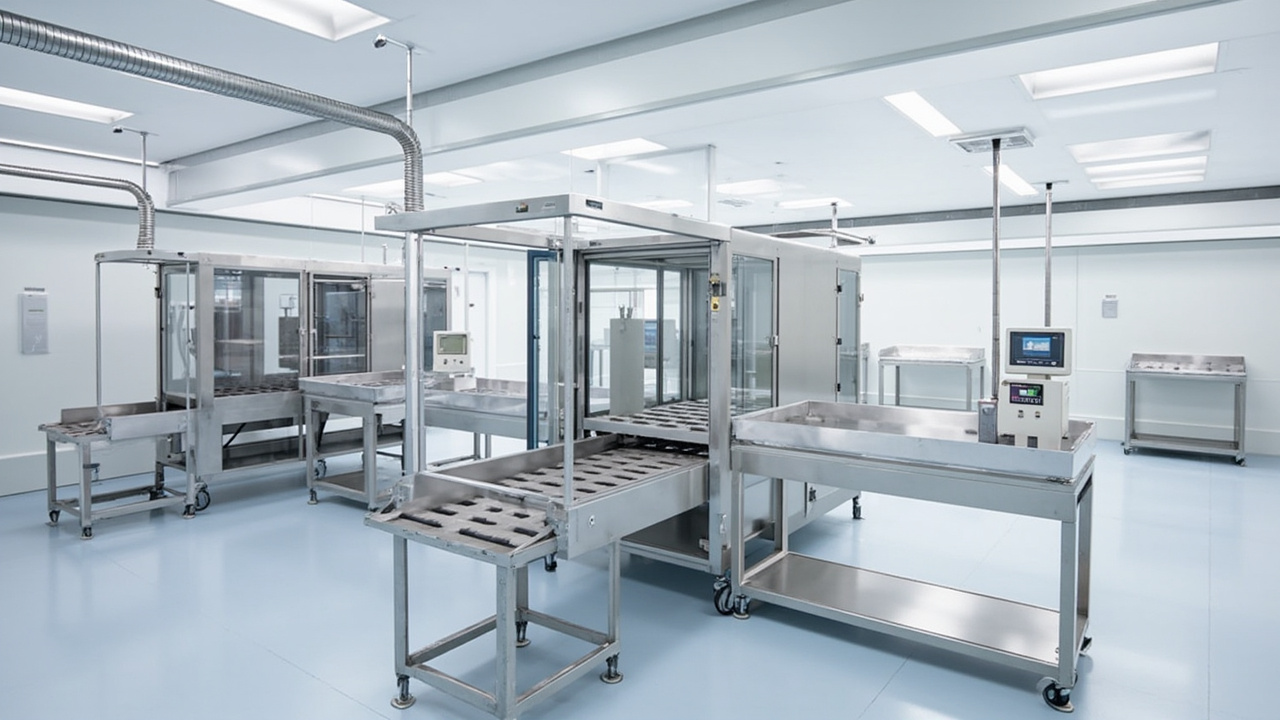
Cleanroom Requirements for Feeder Systems
| Cleanroom Class | ISO Equivalent | Max Particles ≥0.5μm/m³ | Typical Application | Feeder Requirements |
|---|---|---|---|---|
| Class 100 | ISO 5 | 3,520 | Implant assembly, sterile packaging | Enclosed feeder, HEPA-filtered, SUS316L only |
| Class 1,000 | ISO 6 | 35,200 | Syringe assembly, catheter tipping | Enclosed feeder, low-particulate materials |
| Class 10,000 | ISO 7 | 352,000 | Device assembly, packaging lines | SUS316L or coated bowl, sealed controller |
| Class 100,000 | ISO 8 | 3,520,000 | Component staging, non-sterile assembly | SUS304 minimum, covered drive unit |
FDA 21 CFR Part 820 Compliance
Section 820.70(g) requires equipment to be "calibrated, inspected, checked, and maintained" with documented schedules. For feeding systems this means calibration records for controller settings, maintenance schedules for spring replacement and track inspection, and change control for any modification.
Validation: IQ, OQ, and PQ
- Installation Qualification (IQ): Verifies correct installation per specifications
- Operational Qualification (OQ): Confirms operation across full parameter range
- Performance Qualification (PQ): Demonstrates consistent performance under production conditions
Material Requirements for Medical Feeding Systems
SUS316L Stainless Steel
The gold standard for medical feeding bowls. Superior corrosion resistance, smooth polishable surface (Ra ≤ 0.4μm), full traceability through mill test reports, autoclave compatibility up to 134°C, and non-shedding properties suitable for ISO Class 5 cleanrooms.
Medical-Grade Polymers
- PEEK: Autoclavable, chemically resistant, USP Class VI compliant
- PTFE (Teflon): Extremely low friction, chemically inert, FDA-compliant
- Medical-grade polyurethane: Cushioning for delicate parts, low-outgassing grade
- Delrin (acetal): Good mechanical properties for non-sterile applications
Materials to Avoid
SUS410/420 (prone to rust), standard PVC (outgasses and sheds), brass/copper (leaches ions), uncoated aluminum (oxidizes and sheds).
Common Medical Device Parts
- Syringe Barrels and Plungers: Gentle handling to prevent cosmetic defects, 60-120 ppm
- Caps and Closures: Low mass requires precise amplitude control, 200+ ppm
- Orthopedic Implants: High-value titanium/cobalt-chrome, PEEK contact surfaces, 10-30 ppm
- Catheter Components: Flexible/elastomeric, prone to tangling, anti-static essential
- Surgical Instrument Sub-assemblies: Complex geometries, multi-stage orientation
Feeding System Design for Cleanrooms
- Enclosed Drive Units: Sealed housing with gasketed panels, slight positive pressure with HEPA-filtered air
- Hygienic Surface Design: Radiused corners, flush-mounted fasteners, continuous welds, no horizontal surfaces
- Cable Management: Halogen-free, low-outgassing cable jackets, sealed cable glands
- Vibration Isolation: Neoprene or silicone pads rated for operating frequency
Huben Automation: Your Medical Feeding System Partner
Huben Automation brings over 20 years of experience in parts feeding systems for medical device manufacturing. Our ISO 9001 certified quality system ensures documentation and traceability standards that medical manufacturers require. Factory-direct pricing delivers cleanroom-rated systems at 40-60% lower cost than Western suppliers.
Contact Huben Automation to discuss your medical device feeding application. Our engineering team responds within 12 hours.
Ready to Automate Your Production?
Get a free consultation and detailed quote within 12 hours from our engineering team.