Automotive Parts Feeding Solutions from China Manufacturers

The Growing Demand for Automotive Feeding Solutions in China
China is the world's largest automotive market and an increasingly important source of automation equipment for global vehicle manufacturers. Chinese manufacturers now supply vibratory feeding systems to assembly plants across Europe, North America, and Southeast Asia, supporting the production of everything from compact city cars to heavy commercial vehicles. The shift toward electric vehicles has only accelerated this trend, as EV powertrains introduce new component types — battery busbars, connector housings, sensor modules — that all require precise, high-speed feeding into automated assembly cells.
For Tier 1 and Tier 2 suppliers, sourcing feeding equipment from China offers significant cost advantages — typically 40 to 60 percent below European or Japanese equivalents — while maintaining the quality standards that automotive production demands. However, not every China manufacturer understands the unique requirements of automotive parts feeding. This guide explains what automotive buyers should look for, how Chinese manufacturers meet international automotive standards, and which feeding solutions work best for common automotive component categories.
Automotive Quality Standards for Feeding Equipment
Automotive manufacturing operates under the strictest quality regimes of any industry. A single defective component can trigger a recall affecting millions of vehicles. Feeding equipment must therefore meet standards that go far beyond general industrial automation.
IATF 16949 Quality Management
IATF 16949 is the global quality standard for automotive production. While the standard applies primarily to vehicle and part manufacturers, it cascades requirements down to equipment suppliers. A feeder manufacturer serving automotive customers should demonstrate understanding of IATF 16949 clauses including control plans for feeder setup parameters, traceability of parts fed through the system, documented preventive maintenance schedules, and statistical process control for feed rate and orientation yield.
Traceability and Part Serialization
Modern automotive production requires that every component be traceable to its production batch. Feeding systems contribute to this by ensuring that parts are not mixed between lots, that feed counts are recorded against production batch numbers, and that any rejected or misoriented parts are logged. Advanced feeding cells integrate barcode scanners or RFID readers at the discharge point to confirm part identity before assembly.
Production Part Approval Process (PPAP)
When a new feeder is introduced to an automotive line, the customer often requires PPAP documentation. This includes dimensional inspection results, material certifications, process flow diagrams, failure mode and effects analysis (PFMEA), and initial sample inspection reports. A China feeder manufacturer experienced in automotive work should provide PPAP-ready documentation as standard.
Automotive Part Types and Feeding Solutions
Automotive assembly uses thousands of distinct component types, but most fall into five categories that have well-established feeding approaches. Understanding these categories helps buyers specify the right feeder technology and evaluate manufacturer expertise.
| Automotive Part Category | Typical Examples | Feeder Type | Key Requirements |
|---|---|---|---|
| Threaded fasteners | M5-M12 bolts, self-tapping screws, flange nuts, stud bolts | Vibratory bowl feeder or cascade bowl | High speed 80-150 ppm, thread protection, length sorting |
| Sensors and electronic modules | Pressure sensors, temperature probes, ABS sensors, camera modules | PU-coated vibratory bowl + vision verification | Surface protection, ESD safety, precise orientation, gentle handling |
| Electrical connectors | Wire harness connectors, terminal blocks, high-voltage connectors | Custom-tooled bowl with air selection | Pin protection, polarity orientation, tangle prevention |
| Stamped and formed metal parts | Brackets, clips, shielding cans, terminals, bushings | Vibratory bowl or linear feeder | Oil residue handling, burr sensitivity, complex geometry orientation |
| Plastic clips and retainers | Door trim clips, wire retainers, push pins, grommets | Soft-coated vibratory bowl | Static control, lightweight handling, scratch prevention |
Fastener Feeding for Automotive Assembly
Fasteners represent the highest volume feeding application in automotive manufacturing. A single vehicle contains two thousand to three thousand threaded fasteners, and assembly lines must deliver them at rates of eighty to one hundred fifty parts per minute with perfect orientation.
Bolt and Screw Feeding
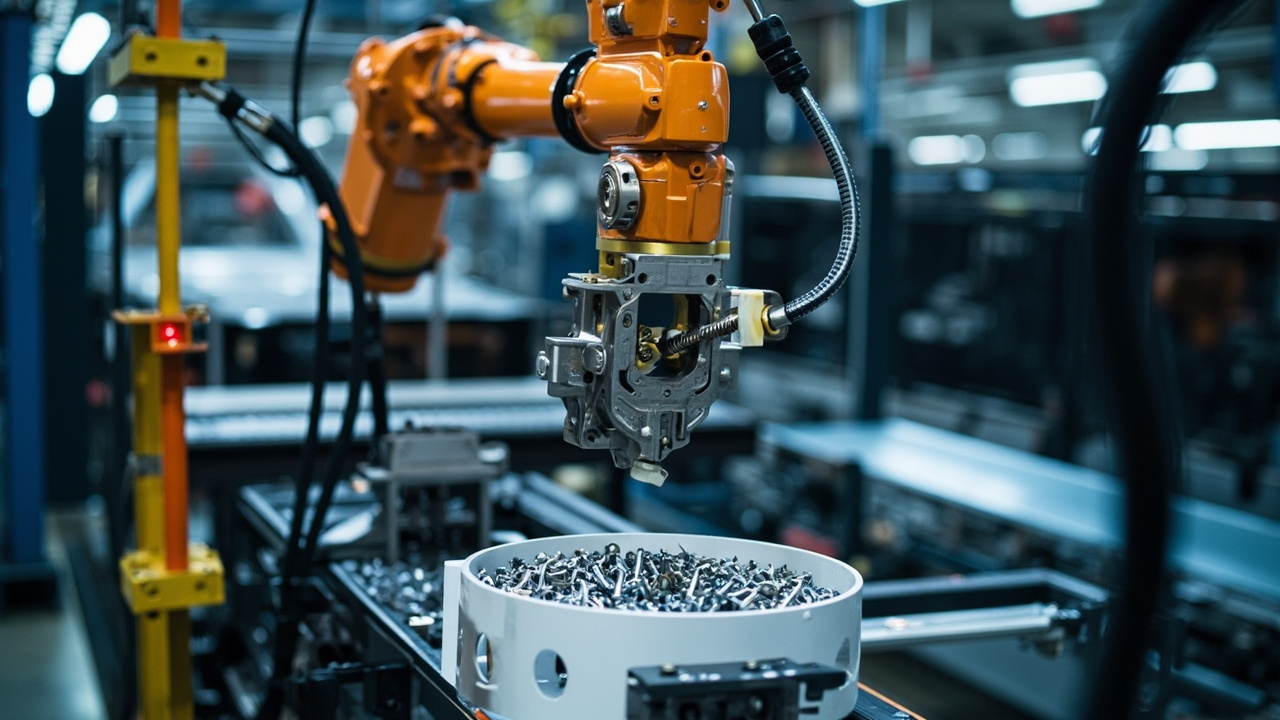
Standard vibratory bowl feeders with spiral tracks remain the most cost-effective solution for bolts and screws in the M5 to M12 range. For high-speed applications, cascade bowl feeders achieve thirty to fifty percent higher feed rates by using a two-stage vibration mechanism. Critical design features include track width matched to fastener diameter with minimal clearance, polyurethane coating to protect threads and finishes, integrated length sorting to reject mixed sizes, and overflow chutes that prevent jamming when the downstream station pauses.
Flange Nut and Special Nut Feeding
Flange nuts, prevailing torque nuts, and cage nuts have asymmetric geometries that complicate orientation. Custom tooling must account for flange orientation, washer capture features, and thread direction. Multi-lane tracks can feed several nuts in parallel to achieve the cycle times required for high-volume assembly.
Self-Tapping and Thread-Forming Screws
These screws often have sharp points and aggressive threads that can damage feeder surfaces or interlock with each other. Track design must prevent point-first stacking, and coating selection must resist abrasion from the screw threads.
Sensor and Electronics Module Feeding
Modern vehicles contain sixty to one hundred sensors monitoring everything from tire pressure to pedestrian detection. These components are expensive, delicate, and must arrive at the assembly station in pristine condition.
Surface Protection Requirements
Sensor housings often have painted, plated, or polished surfaces that scratch easily. Feeding systems must use soft polyurethane or Teflon track coatings throughout the contact path. Vibration amplitude should be reduced to sixty to seventy percent of standard settings to minimize impact forces.
ESD Safety
Electronic sensors and modules are vulnerable to electrostatic discharge. Feeder construction should use ESD-safe materials with surface resistance in the dissipative range of ten to the sixth to ten to the ninth ohms per square. The feeder must be bonded to equipment ground, and ionizing bars should neutralize static charges generated by vibration.
Vision Verification
For the most critical sensors, a vision camera at the feeder discharge confirms correct orientation and detects damaged parts before they reach the assembly robot. This adds two to five thousand dollars to system cost but eliminates the risk of a misoriented or damaged sensor entering the vehicle.
Electrical Connector Feeding
Automotive electrical systems use hundreds of connectors per vehicle, ranging from simple two-pin terminals to complex high-voltage connectors for battery electric vehicles. Connector feeding demands precision that exceeds most other automotive applications.
Pin and Terminal Protection
Connector pins bend easily and must not contact feeder surfaces. Track design uses raised rails that support the connector body while keeping pins suspended in open air. Air-jet selection can reject connectors with bent pins before they exit the feeder.
Complex Geometry Orientation
Connectors have multiple asymmetrical features — locking tabs, keying posts, wire entry directions — that must all be correctly oriented. This requires sophisticated tooling with multiple selection stages. A connector that passes the first orientation gate may still be rejected at the second if a secondary feature is misaligned.
Tangle Prevention
Wire harness connectors with pigtail leads are especially challenging because the leads tangle and knot in the bowl. Solutions include pre-straightening mechanisms, bowl designs that discourage nesting, and vacuum-assisted singulation at the discharge point.
Stamped Metal Part Feeding
Stamped brackets, clips, and terminals emerge from presses coated in forming oil, creating unique feeding challenges. The oil lubricates the stamping process but causes parts to stick together, adhere to feeder surfaces, and attract contamination.
Oily Part Handling
Standard vibratory bowls struggle with oily parts because the oil reduces friction needed for part movement and causes stacking. Solutions include PTFE or hardened chrome track coatings that resist oil adhesion, drainage channels in the bowl base, wider track clearances to prevent oil-induced sticking, and periodic automatic wash-down systems for high-volume applications.
Burr Sensitivity
Stamped edges often have burrs that catch on feeder tooling and cause jams. Bowl design should avoid sharp direction changes where burrs can hook, and track surfaces should be smooth with radiused transitions.
Integration with Automotive Assembly Lines
A feeder in an automotive plant does not operate in isolation. It must integrate mechanically, electrically, and digitally with the surrounding production system.
Mechanical Integration
Vibration isolation prevents feeder vibration from affecting nearby precision stations. Discharge height must match the receiving robot or assembly nest within one to two millimeters. Refill access should be ergonomic for operators who replenish parts every fifteen to thirty minutes. Safety guarding must comply with plant lockout-tagout procedures.
Control System Integration
Automotive lines use industrial Ethernet protocols such as Profinet, EtherNet/IP, or EtherCAT. The feeder controller should communicate part ready signals, bowl empty alarms, and fault conditions to the line programmable logic controller. Part count data should feed into the manufacturing execution system for traceability.
Quick Changeover
With vehicle models changing frequently, feeders must support rapid changeover between part variants. Quick-change bowl inserts allow tooling swap in under fifteen minutes. Recipe-based controller settings store vibration parameters for each part number. RFID-tagged tooling sets ensure the correct insert is installed for the scheduled production run.
Why Source Automotive Feeders from China
China has become a competitive source for automotive feeding equipment for several reasons beyond simple cost reduction.
Manufacturing Scale and Speed
Chinese feeder manufacturers operate in dense industrial ecosystems with immediate access to steel suppliers, machining shops, coating specialists, and controller vendors. This ecosystem enables faster prototyping and shorter lead times than many Western suppliers can achieve.
Engineering Adaptability
China manufacturers have extensive experience with the wide variety of parts produced in the domestic automotive market, from conventional internal combustion vehicles to the latest electric platforms. This breadth of experience translates into creative solutions for complex orientation challenges.
Cost Efficiency Without Compromise
Factory-direct pricing from China typically runs 40 to 60 percent below equivalent European or North American suppliers. Reputable manufacturers achieve this through efficient supply chains and lower overhead, not through reduced material quality or skipped testing.
Selecting a China Automotive Feeder Partner
Not every China manufacturer is prepared for automotive requirements. Buyers should evaluate potential suppliers on specific criteria.
Automotive Track Record
Ask for case studies or references from automotive customers. A manufacturer with IATF 16949 experience or direct supply to Tier 1 suppliers has already learned the documentation and quality disciplines that automotive production demands.
Testing and Validation Capability
Automotive feeders require extensive testing with customer parts. Confirm that the manufacturer can run continuous tests of four hours or more, measure orientation yield statistically, and provide documented factory acceptance testing.
After-Sales Support
Automotive lines run multiple shifts and cannot tolerate extended downtime. Confirm that the manufacturer offers technical support response within twenty-four hours, maintains spare parts inventory, and can provide on-site commissioning assistance when needed.
Huben Automation Automotive Feeding Expertise
Huben Automation has supplied vibratory feeding systems to automotive manufacturers and Tier 1 suppliers worldwide for over twenty years. Our automotive practice includes IATF 16949-aligned quality documentation, complete traceability with material certificates and serialization, PPAP-ready documentation packages, ESD-safe and cleanroom-capable designs, and integration with all major industrial Ethernet protocols.
We understand that automotive downtime costs twelve thousand to fifty thousand dollars per hour, and we engineer our feeders for the reliability that automotive production demands. Our factory-direct pricing delivers this automotive-grade quality at 40 to 60 percent below Western supplier levels.
Contact Huben Automation to discuss your automotive parts feeding application and receive a detailed proposal within twelve hours.
Frequently Asked Questions
Do China feeder manufacturers understand IATF 16949 requirements?
Established manufacturers serving automotive export markets do understand IATF 16949 and can provide control plans, PFMEA documentation, and traceability systems. Always ask for specific automotive references and verify their experience with your application type.
What feed rates can automotive vibratory feeders achieve?
Standard bowl feeders typically achieve sixty to one hundred twenty parts per minute for fasteners. Cascade bowls and multi-lane designs can reach one hundred fifty to three hundred parts per minute. The actual rate depends on part geometry, orientation complexity, and downstream cycle time.
How do automotive feeders prevent part mixing between lots?
Advanced feeding systems include part counting linked to batch numbers, low-level sensors that trigger lot change procedures, and purge cycles that clear the bowl and track before new material is introduced. Some systems integrate barcode verification at the discharge point.
Can China manufacturers provide PPAP documentation?
Yes, experienced automotive feeder suppliers in China can provide full PPAP packages including dimensional results, material certifications, process flow diagrams, PFMEA, control plans, and initial sample inspection reports. Confirm this capability during supplier evaluation.
What is the typical lead time for custom automotive feeders from China?
Standard configurations ship in four to six weeks. Custom-tooled feeders for complex automotive parts typically require eight to twelve weeks including design, tooling fabrication, testing, and factory acceptance. Rush programs can reduce this by two to three weeks with expedited engineering.
How do I verify feeder quality before shipment?
Require factory acceptance testing with your actual production parts, witnessed in person or via live video. Review the FAT protocol before testing begins, and request complete documentation including test data, photographs, and any open item punch list.
Sẵn sàng Tự động hóa Sản xuất?
Nhận tư vấn miễn phí và báo giá chi tiết trong vòng 12 giờ từ đội ngũ kỹ thuật của chúng tôi.