Food Grade Vibratory Feeders: Hygienic Design & Material Standards

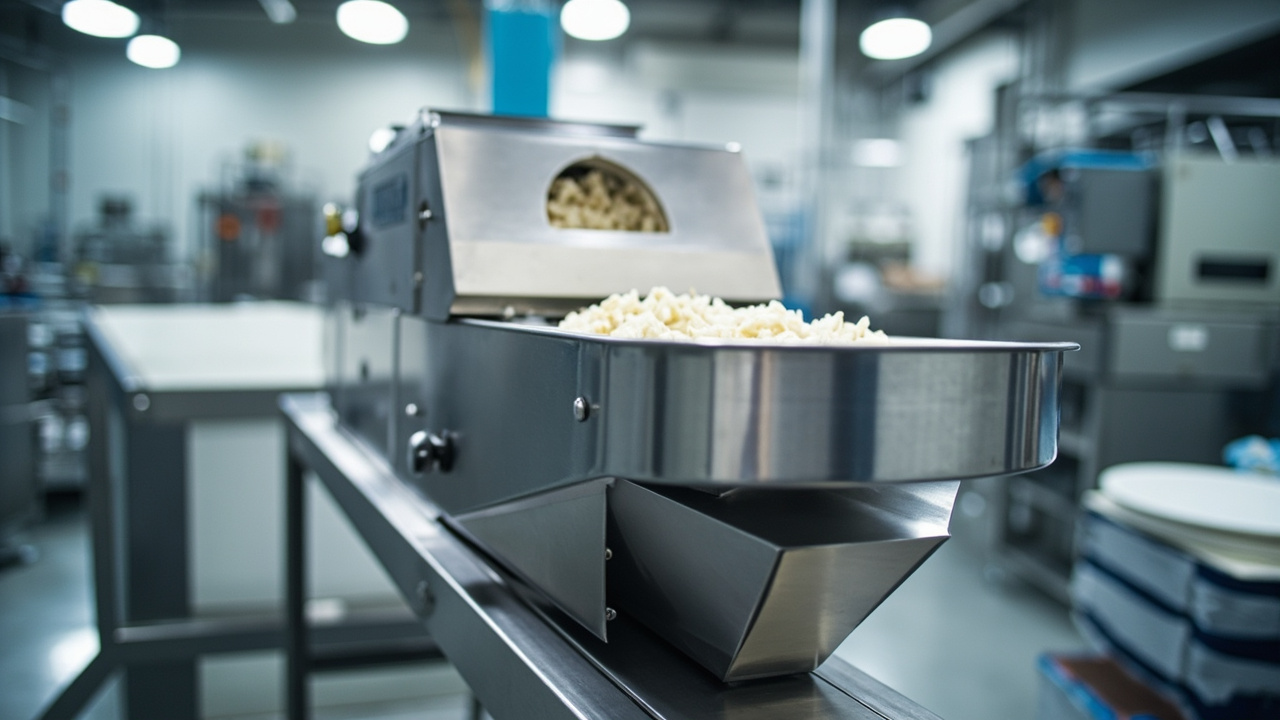
Why food grade vibratory feeders demand a different design philosophy
In food processing and packaging automation, a vibratory feeder is not just a material handling device. It becomes a critical control point in the hygiene chain. Any surface that contacts food or food-contact packaging must be designed, fabricated, and maintained to standards that industrial feeders for metal or plastic parts rarely encounter. The consequences of poor design are severe: product contamination, allergen cross-contact, bacterial harborage, regulatory non-conformance, and costly recalls.
A food grade vibratory feeder must satisfy multiple overlapping requirements simultaneously. It must move product efficiently at the required feed rate. It must present parts in the correct orientation for downstream equipment. And it must do both while remaining cleanable to a microbiological standard, resistant to aggressive sanitation chemicals, and free of crevices where residue can accumulate. These requirements often conflict with the design choices that maximize feeding performance in non-food settings, which is why food-grade feeders are a distinct engineering discipline.
This article explains the regulatory landscape, hygienic design principles, material selection criteria, surface finish standards, and cleaning validation procedures that define a truly food-safe vibratory feeding system. Whether you are feeding caps and closures into a bottling line, conveying confectionery pieces for packaging, or orienting single-serve pods for assembly, the principles remain the same. For related guidance on pharmaceutical and medical feeding requirements, see our pharmaceutical parts feeding guide and medical device automation feeding guide.
Regulatory standards: FDA, EHEDG, and beyond
Food grade vibratory feeders operate within a framework of regional and international standards that define what "food safe" means in practice. Understanding which standards apply to your facility and market is the first step in writing a meaningful equipment specification.
In the United States, the Food and Drug Administration (FDA) regulates materials that contact food under 21 CFR Part 177. This regulation specifies which polymers, coatings, and elastomers are acceptable for food contact. For metals, the FDA does not maintain a specific approved list, but industry practice relies on grades that are generally recognized as safe (GRAS) and suitable for the intended use. Stainless steel grades 304 and 316L are widely accepted for food contact applications when properly finished and maintained.
In Europe, the European Hygienic Engineering and Design Group (EHEDG) publishes guidelines that go beyond material compliance to address equipment design. EHEDG Document 8 covers hygienic equipment design criteria, while Document 13 specifically addresses the cleanability of closed equipment. A feeder designed to EHEDG principles will prioritize smooth surfaces, self-draining geometry, absence of dead legs, and ease of disassembly for manual cleaning where clean-in-place (CIP) is not feasible.
Other relevant standards include 3-A Sanitary Standards in the United States for dairy and liquid food equipment, ISO 14159 for safety of machinery hygiene requirements, and various BRC and SQF audit criteria that food manufacturers must satisfy. A well-specified feeder should be designed with the most stringent applicable standard in mind, because retrofitting hygienic features after delivery is often impractical or impossible.
| Standard or regulation | Region | Primary focus | Feeder design implication |
|---|---|---|---|
| FDA 21 CFR Part 177 | United States | Food-contact materials | All polymers, coatings, and elastomers must be FDA compliant |
| EHEDG Document 8 | Europe | Hygienic equipment design | Smooth surfaces, no dead zones, drainable geometry |
| EHEDG Document 13 | Europe | Cleanability of closed equipment | Validation protocol for cleaning effectiveness |
| 3-A Sanitary Standards | United States | Dairy and liquid food equipment | Stricter surface finish and radius requirements |
| ISO 14159 | International | Safety of machinery hygiene | General hygiene principles for machinery design |
| BRC Issue 9 / SQF Edition 9 | Global | Food safety audit criteria | Equipment must support allergen control and sanitation verification |
Hygienic design principles for vibratory feeders
Hygienic design is the practice of engineering equipment so that it can be cleaned to a microbiological standard without disassembly, or with minimal disassembly if clean-in-place is not achievable. For vibratory feeders, this means rethinking several elements that are routine in standard industrial designs.
The first principle is elimination of crevices and dead zones. Standard bowl feeders often have bolt heads, seams, undercuts, and recesses where product fines and moisture can accumulate. In a food environment, these become bacterial harborage points. A hygienic design replaces countersunk fasteners with smooth welds, eliminates horizontal ledges in the product zone, and ensures that all surfaces are visible and reachable for inspection.
The second principle is self-draining geometry. After wet cleaning, water and cleaning chemistry must drain completely from the equipment. Any pocket that retains liquid becomes a growth medium for microorganisms and a source of chemical contamination for the next product run. Bowl tracks, discharge chutes, and frame members should be angled to promote drainage, and drain holes should be positioned where water naturally collects.
The third principle is accessibility. Even the best-designed equipment requires periodic manual cleaning for allergen changeovers or deep sanitation events. If a contact surface cannot be reached with a cloth, brush, or spray within a reasonable time, the design has failed. This often means wider spacing between frame members, quick-release covers instead of bolted panels, and tool-free removal of contact parts.
The fourth principle is materials compatibility with cleaning regimes. A feeder that survives daily wipe-down may degrade under foam cleaning, high-pressure washdown, or caustic sanitation. The designer must know the full range of cleaning chemicals, temperatures, and pressures that the equipment will encounter over its service life.
Material selection: when 316L stainless steel is essential
Stainless steel is the default material for food-contact surfaces in vibratory feeders, but not all stainless grades are equivalent. The choice between 304 (1.4301) and 316L (1.4404) depends on the corrosivity of the environment, the cleaning chemistry, and the consequences of corrosion.
Grade 304 stainless steel contains 18% chromium and 8% nickel, which provides good general corrosion resistance and excellent fabricability. For many dry-food applications with mild cleaning, 304 is adequate and cost-effective. It is commonly used for frames, guards, and non-contact structural elements even in hygienic equipment.
Grade 316L adds 2-3% molybdenum and has a lower carbon content. The molybdenum significantly improves resistance to chlorides, acids, and pitting corrosion. The lower carbon content reduces sensitization during welding, which helps maintain corrosion resistance in the heat-affected zone. For feeders exposed to salt, acidic foods, aggressive cleaners, or frequent wet sanitation, 316L is the safer choice for product-contact surfaces.
For severe environments, some manufacturers specify 316L with electropolishing. Electropolishing removes a thin surface layer, reducing micro-roughness and improving the passive chromium oxide layer. The result is a smoother, more corrosion-resistant surface that is easier to clean and inspect. However, electropolishing adds cost and may not be necessary for all applications.
| Material | Key properties | Best applications | Limitations |
|---|---|---|---|
| 304 stainless steel | Good corrosion resistance, lower cost, easy to fabricate | Dry food, mild cleaning, non-contact structures | Prone to pitting in chloride environments; weld heat-affected zone may sensitize |
| 316L stainless steel | Superior chloride resistance, low carbon for weld integrity, better for aggressive cleaning | Wet washdown, acidic or salty products, direct food contact | Higher material cost; slightly harder to machine than 304 |
| Electropolished 316L | Ultra-smooth surface, enhanced passive layer, reduced bacterial adhesion | High-hygiene dairy, ready-to-eat, pharmaceutical-adjacent food | Highest cost; mechanical damage removes the enhanced layer locally |
| Food-grade coatings | Can improve release or reduce friction for sticky products | Specific sticky confectionery or bakery applications | Must be FDA compliant; wear and delamination risk requires monitoring |
Surface finish requirements and measurement
Surface finish is one of the most important yet least understood specifications for food-grade vibratory feeders. A rough surface provides more anchor points for bacteria and makes physical removal of residues more difficult. However, an excessively smooth surface may reduce part traction and feeding efficiency, so the specification must balance hygiene and performance.
Surface roughness is typically quantified as Ra (arithmetic average roughness) in micrometers or microinches. For food-contact equipment, common specifications range from Ra 0.8 μm (32 μin) for general food contact to Ra 0.4 μm (16 μin) or better for high-hygiene applications. Some dairy and pharmaceutical standards require Ra 0.25 μm (10 μin) or smoother.
The measurement method matters. Profilometry using a contact stylus is the standard technique, but optical methods are increasingly common for non-destructive inspection. When specifying surface finish, always state the measurement standard (ISO 4287, ASME B46.1) and the cutoff length to ensure consistency between supplier and buyer.
Weld quality is equally important. A rough, unblended weld can have an effective roughness orders of magnitude higher than the surrounding surface, creating a localized hygiene risk. Hygienic welds should be continuous, fully penetrated, ground flush with the parent material, and polished to match the specified surface finish. Weld discoloration should be removed by pickling or passivation to restore corrosion resistance.
Cleaning procedures: from wipe-down to full washdown
The cleaning method determines much of the equipment design. A feeder that is only wiped down daily faces different challenges than one that receives full foam cleaning and high-pressure rinse between every product changeover. The specification should define the cleaning regime before the design is finalized.
For dry, non-allergen products in low-risk environments, daily wipe-down with a food-safe sanitizer may be sufficient. The feeder design must ensure that all contact surfaces are reachable, that cleaning cloths do not snag on sharp edges or fasteners, and that residual sanitizer does not contaminate the next product batch.
For wet cleaning with low-pressure rinse, the feeder must be designed to shed water and drain completely. Electrical components, sensors, and the drive unit must be protected to their rated ingress protection (IP) level, typically IP65 or higher. Cable entries must use hygienic cable glands that do not trap residue.
For full washdown with foam, high-pressure spray, or caustic chemicals, the requirements become stringent. All surfaces must withstand the chemical and thermal shock. The drive unit may need to be sealed or remotely mounted. Control enclosures must be washdown-rated. And the frame must be designed so that no area remains wet after the prescribed drying period.
Validation of cleaning effectiveness is increasingly required by auditors and regulators. This typically involves visual inspection, ATP bioluminescence testing, protein swabs for allergen verification, and periodic microbiological sampling. The feeder design should facilitate all these verification methods by providing accessible sampling points and surfaces that are visible under inspection lighting.
Specific design features for food-grade vibratory feeders
Translating hygienic principles into a working vibratory feeder requires attention to numerous detail decisions. The following features distinguish a purpose-built food-grade feeder from a standard industrial unit with stainless steel panels.
Open-frame construction: Closed box-section frames can trap water and cleaning agents. Open frames with drainable members, rounded corners, and minimal horizontal surfaces are preferred. All tubes should be sealed at the ends to prevent internal contamination.
Quick-release contact parts: Bowl tracks, discharge chutes, and selector tooling that contact food should be removable without tools for cleaning and inspection. Magnetic or cam-lock fasteners are preferable to threaded fasteners in the product zone.
Hygienic feet and mounts: Standard leveling feet with threaded stems create crevices and are difficult to clean. Hygienic feet use solid polymer bases with smooth surfaces and minimal parting lines. They should be bolted through the frame with the bolt head on the outside, not inside a tube.
Sensor and cable management: Sensors should be housed in hygienic enclosures with smooth surfaces. Cables should be routed in hygienic conduits or cable chains that do not create ledges. Excess cable should be managed so it does not drape into the product zone.
Drive unit protection: The electromagnetic drive is the most sensitive component in wet environments. Options include remote mounting of the drive with a hygienic linkage, sealed drive housings with IP69K rating, or placement of the drive outside the washdown zone with a protected bowl suspension.
Frequently asked questions about food-grade vibratory feeders
Is 304 stainless steel sufficient for all food applications?
No. While 304 is acceptable for many dry-food and low-corrosion applications, it is not the best choice for environments with chlorides, acidic products, or aggressive washdown cleaning. For wet sanitation, salty products, or high-audit environments, 316L is the safer specification for product-contact surfaces. The small premium in material cost is usually justified by longer service life and reduced risk of corrosion-related contamination.
What surface finish should I specify for a food-grade vibratory bowl?
For general food contact, specify Ra 0.8 μm (32 μin) or smoother on all product-contact surfaces. For high-hygiene applications such as dairy, ready-to-eat foods, or allergen-controlled lines, specify Ra 0.4 μm (16 μin) or better. Always require weld blending to match the surrounding surface finish. If electropolishing is used, specify the minimum material removal and the final roughness target.
Can I use standard polyurethane or Teflon coatings on a food-grade feeder?
Only if the coating is explicitly FDA compliant for the intended food-contact application under 21 CFR Part 177. Many industrial coatings are not food grade. Even compliant coatings must be monitored for wear, delamination, and degradation under your specific cleaning chemistry. In many cases, bare polished stainless steel is the lowest-risk option for product-contact surfaces because it eliminates coating failure as a contamination source.
How do I validate that my food-grade feeder is cleanable?
Develop a cleaning validation protocol that includes visual inspection, ATP swabbing, protein or allergen-specific swabs, and periodic microbiological testing. Define acceptance criteria for each test method. Run the protocol after the worst-case soiling condition and verify that all sampling points meet criteria. Document the results and revalidate whenever the product, cleaning method, or equipment design changes.
What IP rating should the electrical components have in a washdown environment?
For low-pressure wet cleaning, IP65 is generally sufficient. For high-pressure washdown or foam cleaning, specify IP66 or IP69K for components in the direct spray zone. The drive unit, controller, sensors, and junction boxes should all be rated for the most severe cleaning condition they will encounter. Remember that IP ratings apply to the enclosure as installed, not just the component in isolation.
Should the drive unit be inside or outside the washdown zone?
Whenever possible, mount the electromagnetic drive unit outside the washdown zone or use a sealed, washdown-rated drive. Remote drive mounting with a hygienic suspension linkage is a proven solution for severe washdown environments. If the drive must be in the wet zone, it must be rated for the cleaning method and have drainage provisions so that water does not pool in the housing.
Building a specification that protects your product and your brand
A food grade vibratory feeder is more than a stainless steel bowl on a frame. It is a hygiene-critical piece of equipment that must satisfy regulatory requirements, withstand aggressive cleaning, and maintain feeding performance over thousands of sanitation cycles. The cost of getting it wrong is measured in contamination events, audit failures, and reputational damage that far exceeds any equipment savings.
The key to success is writing a complete specification before requesting quotes. Define the applicable regulatory standards. Specify the material grades and surface finishes. Describe the cleaning method and validation requirements. And demand that suppliers explain how their design addresses each hygienic design principle, not just the feed rate and bowl size.
Huben Automation designs and manufactures food-grade vibratory feeding systems for clients worldwide, with factory-direct engineering support from concept through validation. Our food-grade feeders are built with 316L contact surfaces, hygienic open-frame construction, and cleanability as a primary design criterion. If you are planning a food or beverage automation project, contact our engineering team to review your hygiene requirements and product handling challenges. For a broader overview of feeding system options, visit our vibratory bowl feeder product page or explore our parts feeding system solutions guide.
พร้อมที่จะทำระบบอัตโนมัติในการผลิตของคุณ?
รับคำปรึกษาฟรีและใบเสนอราคาละเอียดภายใน 12 ชั่วโมงจากทีมวิศวกรของเรา