Cosmetic Industry Parts Feeding: Caps, Pumps & Applicator Solutions

The unique challenges of feeding cosmetic components
Cosmetic packaging components present some of the most demanding feeding challenges in automated manufacturing. Unlike industrial hardware where a scratch or scuff mark is irrelevant to function, cosmetic parts are sold on appearance. A cap with a visible mar, a pump with a surface blemish, or an applicator with bent bristles becomes a consumer-reject defect that can trigger batch returns and brand damage. The feeder must therefore deliver not only the correct orientation and feed rate, but also pristine surface condition.
The diversity of cosmetic part types adds complexity. A single product line may include screw caps, snap-fit closures, lotion pumps with multiple internal components, mascara brushes with delicate bristles, lipstick applicators with soft foam tips, and jar lids with decorative metallized finishes. Each part family has different geometry, surface sensitivity, orientation requirements, and downstream presentation needs. No single feeding technology handles all of them optimally.
This article provides a comprehensive guide to feeding cosmetic industry components, covering the specific requirements for caps, pumps, brushes, and applicators. We discuss surface protection strategies, high-speed feeding for packaging lines, tooling design for complex geometries, and integration with downstream capping, filling, and assembly equipment. For related reading on pump-specific feeding, see our cosmetic pump parts feeding guide, and for cap handling see our cap and lid feeding guide.
Understanding cosmetic part types and their feeding requirements
Cosmetic components fall into several categories, each with distinct handling characteristics. Understanding these differences is essential for selecting the right feeding technology and designing appropriate tooling.
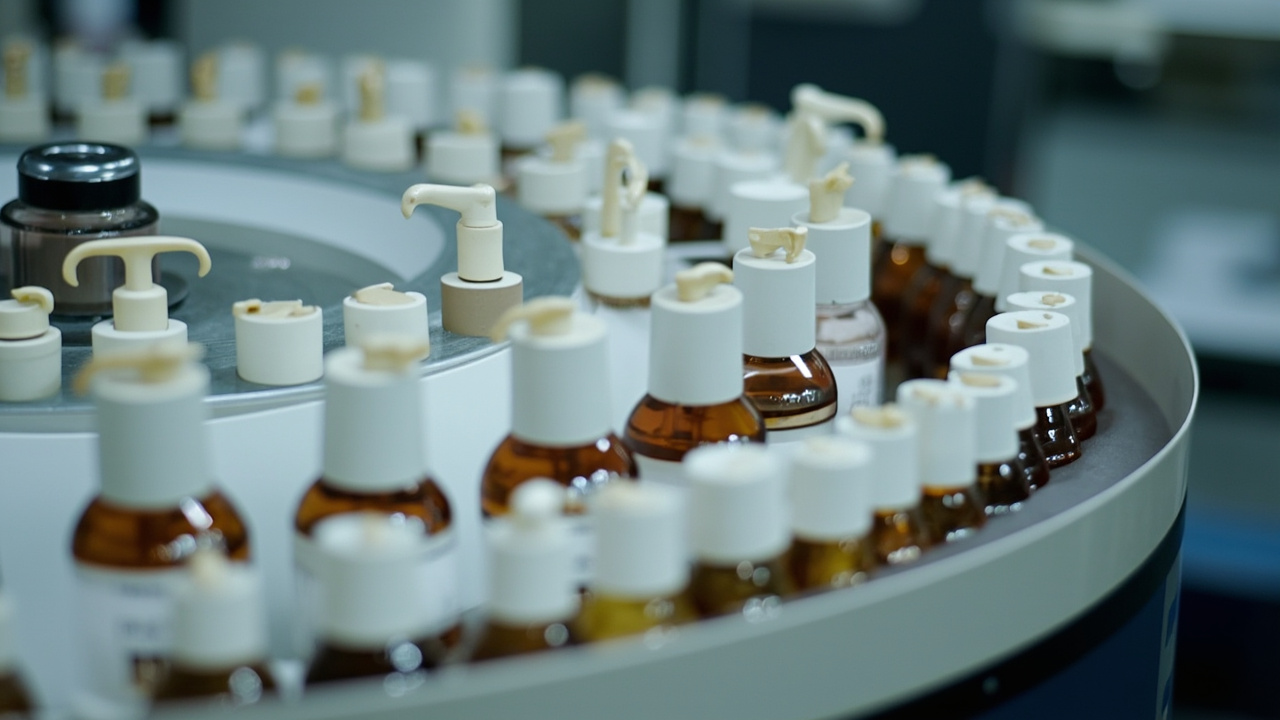
Screw caps and closures: These are typically injection-molded plastic parts with external threads, internal sealing features, and often a decorative top surface. They are relatively robust but may have soft-touch coatings, metallized finishes, or printed logos that are easily damaged. The main feeding challenge is orienting the cap consistently (top-up or top-down) while preventing surface contact with hard tooling during the orientation process.
Lotion and spray pumps: Pump assemblies consist of multiple components: the actuator head, the pump body, the piston, the spring, and the dip tube connector. These parts often have asymmetric geometry with delicate locking features that can be damaged by aggressive mechanical selectors. The feeder must present each component in the exact orientation required by the assembly station, which may differ for each sub-component.
Mascara brushes and applicators: These are the most fragile cosmetic components. Mascara brushes have fine plastic or nylon bristles that bend permanently if compressed or scraped. Wand applicators have slender stems that can snap if dropped from height or subjected to impact. Traditional vibratory bowl feeding is often unsuitable for these parts because the vibration and part-to-part contact cause bristle damage.
Jar lids and compact cases: These are typically larger, flatter parts with decorative surfaces. They may have mirror finishes, embossed logos, or soft-touch coatings. Their flat geometry makes them prone to stacking and nesting, which complicates singulation. The feeder must separate individual lids without scratching the visible surface.
| Cosmetic component | Key feeding challenge | Primary risk | Recommended approach |
|---|---|---|---|
| Screw caps and closures | Orientation without surface damage | Scratches on decorative finish | Coated bowl with soft selector tooling |
| Lotion pump actuators | Asymmetric geometry, multiple features | Damage to locking clips or snap fits | Precision vibratory bowl with custom track geometry |
| Pump bodies and pistons | Small size, internal features | Wrong orientation, feature damage | Step feeder or flexible feeder with vision |
| Mascara brushes | Extremely delicate bristles | Bristle deformation or breakage | Tray feeding or gentle linear conveyor |
| Wand applicators | Slender stem, top-heavy geometry | Stem bending or breakage | Soft pocket conveyor or robotic pick from tray |
| Jar lids and compacts | Flat shape, nesting tendency | Surface scratching, double feeds | Escalator feeder or centrifugal bowl with air separation |
Surface finish protection: the non-negotiable requirement
In cosmetic feeding, surface protection is not a nice-to-have feature. It is the primary design criterion. The visible surface of a cosmetic component is the product that the consumer evaluates at the point of purchase. Any feeder design that sacrifices surface quality for speed or simplicity is fundamentally flawed for this industry.
The first line of defense is bowl and track coating. Standard uncoated steel or stainless steel bowls are too abrasive for most cosmetic parts. Polyurethane (PU) coatings provide a softer contact surface that reduces scratching. For very delicate parts, specialized soft coatings with Shore hardness below 60A can further reduce contact damage. The coating must be applied uniformly because any thin spot or edge becomes a scratch source.
The second line of defense is track geometry design. Sharp corners, abrupt transitions, and narrow slots where parts can jam and scrape must be eliminated. All tooling edges that contact the part should have generous radii. Selector blades should be designed so that rejected parts fall away gently rather than being scraped off the track. Air jets, where used for rejection, should be positioned and pressure-regulated to avoid part-to-part impact.
The third line of defense is recirculation management. In a vibratory bowl, parts circulate many times before reaching the discharge point. Each recirculation cycle is an opportunity for surface damage. Reducing recirculation by optimizing bowl fill level, adjusting feed rate to match downstream demand, and using dual-speed controllers can significantly reduce cumulative contact damage.
For the most sensitive parts, alternative feeding technologies may be necessary. Tray-based feeding presents parts in pre-formed pockets with no part-to-part contact. Flexible feeders with vision-guided robots handle parts gently and can adapt to multiple geometries without tooling changes. While these technologies have higher capital cost, they may be justified when reject costs from surface damage are high.
High-speed feeding for cosmetic packaging lines
Cosmetic packaging lines operate at speeds that challenge even experienced feeding engineers. A high-volume mascara line may require 300 units per minute. A shampoo bottling line may need 400 caps per minute. At these speeds, the feeder must not only deliver parts quickly but also maintain the surface quality and orientation precision that cosmetic assembly demands.
The key to high-speed cosmetic feeding is matching the feeder output to the actual consumption pattern of the packaging machine. Continuous high-speed operation is rarely required. Most packaging machines have intermittent demand: the feeder runs at high speed during the machine's open window and slows or stops when the machine is not calling for parts. This duty cycle allows the feeder to use higher amplitude during the fill phase and gentler vibration during the sustain phase, reducing overall part contact time.
Buffer management is critical. A well-designed feeding cell includes a buffer zone between the feeder discharge and the packaging machine infeed. This buffer absorbs the mismatch between the feeder's continuous output and the machine's intermittent demand. The buffer should be designed with the same surface protection principles as the feeder itself, because parts in the buffer are still at risk of cosmetic damage.
Multi-lane feeding can multiply effective output without increasing bowl speed. By splitting the single feeder discharge into two or more parallel lanes, each lane operates at a lower speed while the total output meets the line requirement. This approach reduces part velocity, recirculation, and contact damage in each lane. However, it requires precise lane balancing to avoid starvation or overflow in any single lane.
Tooling design for complex cosmetic geometries
Cosmetic parts often have complex geometries that make orientation challenging. A pump actuator may have a narrow stem, a wide head, and an asymmetric locking tab. A cap may have internal threads that are invisible from the outside. A brush may have no stable resting orientation at all. Effective tooling design is what separates a reliable cosmetic feeder from a source of constant jams and misorients.
The tooling design process should begin with a thorough analysis of the part's center of gravity, contact surfaces, and feature geometry. 3D scanning and CAD modeling allow the tooling designer to simulate part behavior on the track before any metal is cut. This virtual prototyping reduces iteration time and helps identify orientation strategies that may not be obvious from physical inspection alone.
For parts with clear asymmetry, mechanical selectors such as wiper blades, cutouts, and grooves are effective. The selector should engage the part on a non-critical surface whenever possible. For example, a cap should be oriented by its skirt or thread root, not by its decorative top. A pump body should be supported by its robust base, not by its delicate actuator stem.
For parts with subtle or no asymmetry, vision systems may be necessary. A camera above the discharge point can verify orientation and reject misoriented parts before they reach the packaging machine. While vision adds cost and complexity, it is often the only reliable solution for parts that cannot be distinguished by mechanical means alone.
Integration with downstream capping, filling, and assembly
A cosmetic feeder does not operate in isolation. It is part of a larger packaging or assembly system that includes filling machines, capping heads, labeling stations, and cartoning equipment. The feeder design must account for the mechanical, electrical, and control interfaces with all downstream equipment.
The discharge height and position must match the downstream machine's infeed exactly. Cosmetic packaging machines often have tight envelope constraints, and a feeder that discharges 20 millimeters too high or too far to the left may not fit the available space. Early coordination between the feeder supplier and the packaging machine supplier prevents costly rework during installation.
Control integration is equally important. The feeder controller must respond to downstream demand signals, typically via digital I/O or fieldbus communication. When the packaging machine signals that it needs parts, the feeder should accelerate smoothly to the required rate. When the machine stops, the feeder should decelerate gently to avoid part tumbling and surface damage. Hard start-stop cycles are particularly damaging to cosmetic components.
Changeover support is a major consideration in cosmetic manufacturing. Packaging lines often run multiple SKUs with different caps, pumps, or applicators. The feeder should be designed for quick changeover, with modular tooling that can be swapped without extensive adjustment. Changeover time directly impacts line utilization, and in cosmetic manufacturing where campaigns may be only a few hours, rapid changeover is a significant competitive advantage.
Frequently asked questions about cosmetic parts feeding
Can standard vibratory bowl feeders handle cosmetic components?
Standard uncoated steel bowl feeders are generally unsuitable for cosmetic components because the hard steel surface causes scratching and scuffing on visible plastic and metallized finishes. For cosmetic applications, the bowl must have a soft coating such as polyurethane, and the tooling must be designed with generous radii and gentle selectors. For extremely delicate parts like mascara brushes, alternative technologies such as tray feeding or flexible feeders are often necessary.
What coating is best for protecting cosmetic part surfaces in a vibratory feeder?
Polyurethane (PU) coatings with Shore hardness between 60A and 90A are the most common choice for cosmetic feeding. They provide a good balance between surface protection and durability. For very soft or highly polished parts, specialty coatings with lower hardness or additives that reduce friction may be used. The coating must be applied uniformly and inspected regularly for wear, because any exposed metal substrate becomes an immediate scratch risk.
How do I prevent part-to-part contact damage in high-speed cosmetic feeding?
Reduce recirculation by optimizing the bowl fill level and using a controller with dual-speed capability. Maintain a buffer between the feeder and the packaging machine so the feeder can run at a steady rate rather than cycling on and off. Consider multi-lane discharge to reduce the speed in each individual lane. For the most sensitive parts, use a feeder technology that eliminates recirculation entirely, such as step feeders or tray-based presentation.
What is the typical feed rate for cosmetic caps and pumps?
Feed rates vary widely depending on part size, geometry, and surface sensitivity. Small screw caps for bottles may feed at 200-400 parts per minute from a single vibratory bowl. Larger pump actuators with complex orientation requirements may achieve 80-150 parts per minute. Multi-lane or multi-bowl configurations can multiply these rates to meet high-speed packaging line demands. The actual achievable rate must be validated with production-representative parts under cosmetic acceptance standards.
How do I handle frequent SKU changeovers on a cosmetic packaging line?
Design the feeder with modular, quick-change tooling that can be swapped in minutes rather than hours. Document the setup parameters for each SKU, including amplitude, frequency, air jet pressures, and selector positions. Use digital controllers with preset storage so that each SKU can be recalled automatically. Consider flexible feeder technology for high-mix lines where mechanical tooling changeover would be impractical.
Should I use vision inspection with my cosmetic feeder?
Vision inspection is recommended whenever the cosmetic standard cannot be reliably met by mechanical orientation alone, or when the downstream process requires verification of features that are not mechanically detectable. Vision can verify orientation, detect surface defects, and confirm the presence of critical features such as threads or locking tabs. The decision to add vision should be based on the reject cost, the mechanical orientation difficulty, and the downstream process requirements.
Delivering cosmetic feeding systems that protect your brand
Cosmetic parts feeding is a specialized discipline that demands equal attention to throughput, orientation accuracy, and surface quality. A feeder that delivers the right part at the right speed but damages the visible surface is a failure in this industry. Success requires careful selection of feeding technology, thoughtful tooling design, appropriate surface protection, and tight integration with downstream packaging equipment.
The investment in a well-engineered cosmetic feeding system pays dividends in reduced reject rates, higher line efficiency, and protected brand reputation. Skimping on surface protection or forcing unsuitable parts into standard feeders may save capital in the short term, but the ongoing cost of cosmetic rejects, customer complaints, and rework quickly erases any initial savings.
Huben Automation designs and manufactures cosmetic parts feeding systems with surface protection as a primary engineering criterion. Our factory-direct approach means you work directly with the engineers who design your tooling, select your coatings, and tune your controllers for gentle, high-speed handling. If you are planning a cosmetic packaging or assembly automation project, contact our team to discuss your specific components and quality requirements. You can also explore our vibratory bowl feeder products or read our plastic parts feeding guide for additional material-specific guidance.
พร้อมที่จะทำระบบอัตโนมัติในการผลิตของคุณ?
รับคำปรึกษาฟรีและใบเสนอราคาละเอียดภายใน 12 ชั่วโมงจากทีมวิศวกรของเรา