How to Design Vibratory Bowl Feeder Tooling: Complete Engineering Guide

What Is Vibratory Bowl Feeder Tooling?
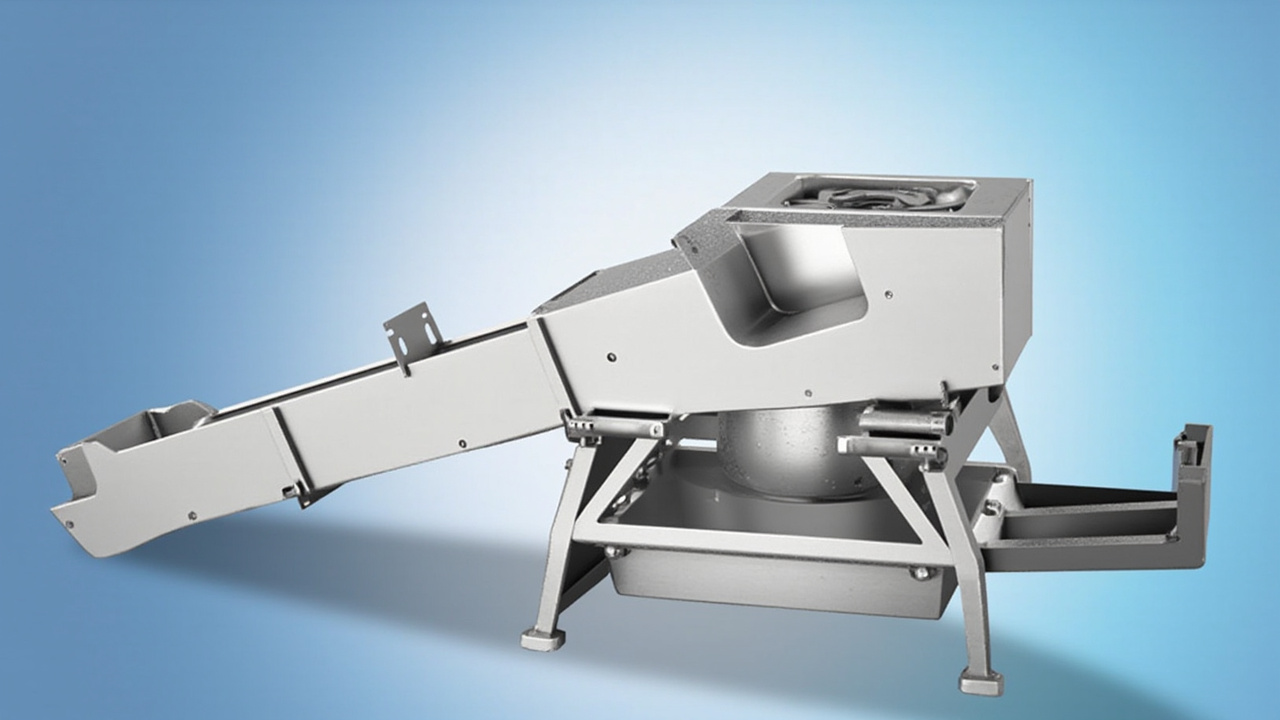
Tooling is the custom-engineered mechanical features inside a vibratory bowl feeder that orient, select, and guide parts from a random bulk state into a single, consistent presentation at the discharge point. Without properly designed tooling, a bowl feeder is simply a vibrating container — parts will move but will never achieve the consistent orientation your downstream process requires.
Tooling includes every feature machined, welded, or bolted onto the bowl's inner track surface: baffles, selectors, wipers, cutouts, air jets, vision stations, and discharge chutes. Each element serves a specific purpose in the orientation sequence, and the entire tooling set must work together as an integrated system. A single poorly designed tooling element can cause jamming, misorientation, or feed rate drops that cascade through the entire production line.
In practice, tooling design accounts for 60-80% of the total engineering effort in a custom vibratory bowl feeder project. The bowl, drive unit, and controller are relatively standardized — it is the tooling that makes each feeder unique to its application.
Types of Orientation Mechanisms
Orientation mechanisms are the core of feeder tooling. Each mechanism exploits a specific geometric or physical property of the part to filter out incorrect orientations and allow only the desired one to pass.
Baffles and Deflectors
Baffles are fixed barriers mounted above or alongside the track that physically block parts in incorrect orientations while allowing correctly oriented parts to pass underneath or through a gap. Deflectors work similarly, redirecting misoriented parts back into the bowl center for another attempt.
- Best for: Parts with significant height or width differences between orientations
- Advantage: No moving parts, zero maintenance, highly reliable
- Limitation: Cannot distinguish between orientations with similar profiles
- Design tip: Set baffle clearance to 1.0-1.5mm above the correct part height to allow for vibration amplitude variation
Selectors and Cutouts
Selectors are precision-machined openings in the track that allow only correctly oriented parts to pass through while misoriented parts fall back into the bowl.
- Best for: Parts with distinct cross-sectional profiles
- Advantage: Very high orientation accuracy (99.5%+)
- Limitation: Requires precise machining, sensitive to part tolerance variations
- Design tip: Add 0.2-0.5mm clearance to the cutout profile to accommodate part tolerances
Air Jets and Blow-Offs
Air jets use directed compressed air streams to blow misoriented parts off the track while leaving correctly oriented parts undisturbed.
- Best for: Lightweight parts, parts where mechanical tooling would cause damage
- Advantage: Gentle on parts, adjustable pressure and angle, easy to modify
- Limitation: Requires clean compressed air supply (0.3-0.6 MPa)
- Design tip: Position the air jet 3-8mm from the part surface at a 30-45 degree angle
Vision-Guided Orientation
Vision systems use cameras and image processing to identify part orientation in real time, then trigger pneumatic reject mechanisms or robotic pick-and-place.
- Best for: Parts with subtle orientation differences, multi-product lines
- Advantage: Handles virtually any part geometry, programmable for product changeovers
- Limitation: Higher cost, requires lighting and programming
- Design tip: Ensure consistent backlighting and allow 150-300ms per part for image processing
Huben Expert Tip
Always provide your automation supplier with the exact production parts, including edge-case defective parts. Designing tooling around perfect CAD models often leads to jamming in real-world scenarios.
Tooling Type Comparison
| Tooling Type | Accuracy | Speed | Cost | Flexibility | Best Application |
|---|---|---|---|---|---|
| Baffles / Deflectors | 90-95% | High | Low | Low | Simple parts with obvious orientation differences |
| Selectors / Cutouts | 99%+ | High | Medium | Low | Parts with distinct cross-sectional profiles |
| Air Jets | 95-98% | Medium-High | Medium | Medium | Lightweight or delicate parts |
| Vision Systems | 99%+ | Medium | High | High | Complex parts, multi-product lines |
| Combined Mechanical + Air | 99%+ | High | Medium | Medium | Most production applications |
Tooling Design Process: Step by Step
- Analyze the Part — Document every dimension, tolerance, and geometric feature. Identify all stable resting orientations. Measure with calipers or CMM and determine the center of gravity for each orientation.
- Define the Orientation Sequence — Map the logical sequence of tooling elements. Each step should handle one orientation decision. For example: baffle → track cutout → air jet → discharge chute.
- Design Each Tooling Element — One function per element, generous lead-in angles (15-30°), track width 1.2-1.5× max part width, clear reject paths, and adjustable mounting brackets.
- Validate with Prototyping — Test with 3D-printed tooling elements and 200-500 parts to verify orientation accuracy and feed rate.
- Fabricate and Test — Produce final tooling, install, and conduct full run-off test with production-quantity parts.
Material Selection for Tooling
| Material | Durability | Machinability | Best For |
|---|---|---|---|
| SUS304 / SUS316L | 10+ years | CNC milling, wire EDM, laser cutting | General production tooling |
| SKD11 / D2 Tool Steel | 5-10+ years (HRC 58-62) | Requires EDM after hardening | High-wear elements, abrasive parts |
| Delrin (POM) / Nylon (PA6) | 2-5 years | Excellent — conventional milling | Delicate parts, noise reduction |
| Urethane / Rubber | 1-2 years (replaceable) | Molded inserts | Glass parts, cosmetic components |
Tooling for Different Part Geometries
Screws and Fasteners
Combine a baffle to reject standing orientations, a V-track to cradle the shank, a head selector cutout, and an air jet at the transition point. For socket-head cap screws, add a center-post selector.
Flat Parts (Washers, Discs, Shims)
Use a step track where the surface drops by slightly more than one part thickness, a wiper blade set at one part thickness above the track, and consider a centrifugal pre-feeder for high-speed applications.
Complex and Asymmetrical Shapes
Use profile selectors matching the unique cross-section, multi-stage orientation with 3-5 sequential elements, or vision-guided selection when mechanical tooling alone cannot reliably distinguish orientations.
Common Tooling Design Mistakes
- Insufficient clearance tolerances — Always add 0.2-0.5mm clearance to critical dimensions
- Overcomplicating a single element — Break complex tasks into multiple simple stages
- Neglecting reject paths — Every rejected part needs a clear path back to the bowl center
- Ignoring part-to-part variation — Test with parts from multiple production batches
- Fixed tooling without adjustability — Use slotted mounting holes and adjustable brackets
- Inadequate air jet positioning — Position 3-8mm from part surface at 30-45° angle
Testing and Validation
Conduct prototype testing with 200-500 parts measuring orientation accuracy (target 99%+), feed rate, reject rate (under 30%), and jam frequency (target zero). Follow with a minimum 2-hour production run-off test and part variation testing across at least three production batches.
Expert Tooling Design from Huben Automation
Tooling design is where experience makes the difference between a feeder that works and one that works reliably for years. Huben Automation has designed tooling for over 200+ custom feeder projects across automotive, electronics, medical, and consumer goods industries. Our ISO 9001 certified quality system ensures every tooling element is dimensionally inspected, and every completed feeder undergoes a full run-off test with your actual production parts. Our factory-direct pricing means expert tooling at competitive rates — typically 40-60% less than equivalent Western suppliers.
Contact Huben Automation for custom tooling design, feeder optimization, or a free consultation on your parts feeding challenges.