Rubber Parts Feeding Guide 2026

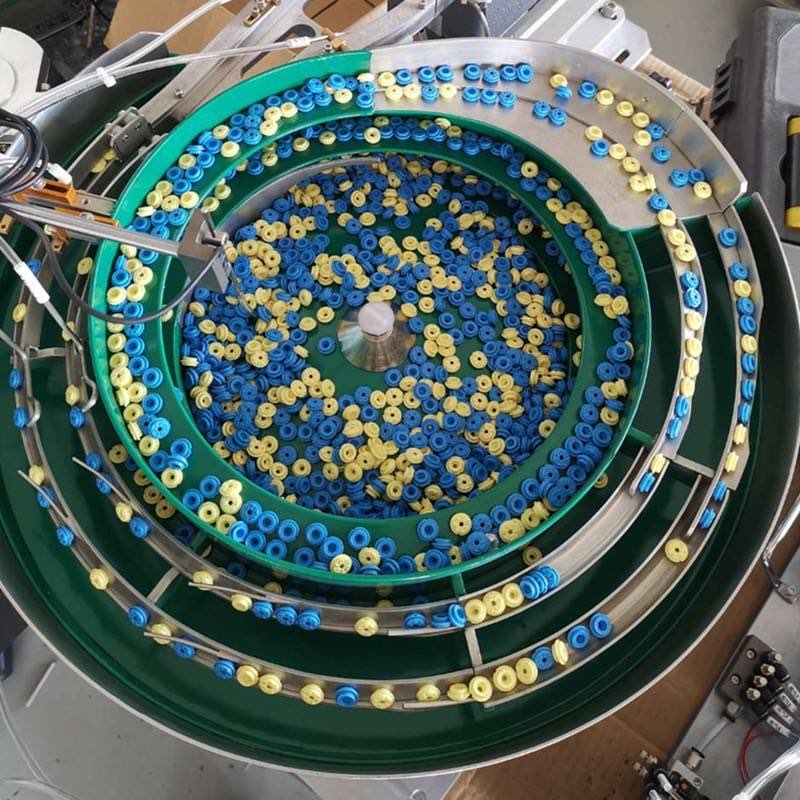
Soft rubber parts behave very differently from hard plastics or metal
Rubber parts feeding has its own set of headaches. Soft parts stick together, compress under load, react to temperature, and sometimes arrive with enough mold release or talc residue to change friction completely from lot to lot.
This is why a feeder that runs plastic parts well may still struggle badly on elastomer parts. The problem is rarely that the machine cannot move the part. The problem is that the part does not keep a stable shape or surface behavior while it moves.
This guide explains how to reduce sticking, deformation, and unstable presentation on soft rubber components. It also shows when a flexible feeder becomes easier to live with than trying to tune a bowl around too many variables.
Why soft elastomer parts misfeed
Compression under bulk load is the first issue. When soft parts pile up, the lower layers change shape enough to affect how they sit in pockets or on guide rails. That creates inconsistent orientation later in the track.
Surface tack is the second problem. Some elastomers cling to each other or to the feeder surface. Others carry mold release or powder that makes them slide too much. Either way, the feeder needs to be designed around the real part condition, not the ideal part drawing.
Static can also matter, especially on smaller lightweight rubber components. Buyers sometimes think of static as a plastic-parts issue only. It can still affect soft material presentation.
| Rubber-part condition | Visible symptom | Likely cause | Practical fix |
|---|---|---|---|
| Soft thick elastomer | Pocket inconsistency | Compression under load | Lower bowl fill and review tooling contact |
| Tacky surface | Part pairs or clusters | High surface adhesion | Open separation zone and simplify selectors |
| Powdered finish | Slip and poor climb | Low friction on track | Review coating or track angle |
| Small light seals | Static cling | Dry environment | Add anti-static controls and calmer motion |
Choosing the feeder concept
Standard bowl feeders still make sense on single elastomer parts with stable dimensions and reasonable output targets. The bowl usually needs a softer, less aggressive tooling layout than a feeder built for hard parts.
Flexible feeders are more attractive when the line changes among several soft parts or when the part deforms too easily under fixed mechanical selection. They give up speed, but often gain process stability.
The key question is whether the part can tolerate repeatable mechanical contact without changing the very shape the feeder is trying to control.
Rules that usually improve rubber-part feeding
Rubber feeders get better when engineers reduce bulk pressure and stop overcomplicating the track.
- Keep the bowl fill controlled. Soft parts become less predictable when they are buried under excess part load.
- Use simpler selectors. Tacky parts often perform worse when the tooling path gets too busy.
- Validate on real ambient conditions. Temperature and humidity can move the result more than expected.
- Separate lots by material if necessary. Different hardness or finish conditions may need different settings.
For soft parts, a stable and forgiving path usually outperforms a clever but delicate one.
Validation points before approval
Run the feeder at realistic room conditions and with production parts from more than one lot if available. Soft-part feeders are especially sensitive to normal process variation.
Watch for shape change at the discharge, not only inside the bowl. A part that arrives flattened, twisted, or paired still creates downstream trouble even if the count looks fine.
If the line uses robot pickup or insertion, validate the handoff carefully. Soft parts can land in the right place while still being presented in the wrong shape.
Buyer checklist for rubber-part feeder RFQs
Soft-part quotations improve a lot when buyers provide the real handling constraints.
- Send material family and hardness. Different elastomers behave differently even at similar size.
- Provide multiple production samples. Surface finish and mold-release condition matter.
- State the acceptable part deformation. The feeder concept changes if shape must remain tightly controlled.
- Describe the next process. Assembly, inspection, and robot pickup stress the output differently.
Huben Automation reviews rubber-part feeders around real material behavior, not just nominal geometry. If you want help checking a soft-part application, send us the sample and process details.