How to Reduce Vibratory Feeder Noise: Engineering Solutions

The Business Case for Quieter Vibratory Feeders
Noise on the factory floor is not merely an annoyance — it is a measurable cost center. Excessive noise from vibratory feeders contributes to operator fatigue, increases error rates, drives turnover in sensitive individuals, and exposes employers to regulatory liability. In the European Union, the Physical Agents Directive 2003/10/EC mandates employer action at 80 dB(A) and sets an absolute exposure limit of 87 dB(A). In the United States, OSHA's 29 CFR 1910.95 requires a hearing conservation program at 85 dB(A) and engineering controls at 90 dB(A). Facilities that fail to comply face fines, litigation, and restrictions on operating hours.
Beyond compliance, there is a compelling operational case for noise reduction. Studies consistently show that sustained noise levels above 75 dB(A) degrade cognitive performance, increase reaction time, and elevate stress hormone levels. On assembly lines where operators perform visual inspection or fine motor tasks, a 5 dB reduction in background noise correlates with measurable quality improvements. In cleanroom and medical device environments, noise reduction is often a customer requirement written into supplier quality agreements.
This guide presents engineering solutions for reducing vibratory feeder noise. The approaches range from simple maintenance and tuning adjustments that cost nothing but labor, to structural modifications such as isolation mounts and acoustic enclosures, to alternative feeder technologies for noise-critical applications. Each solution is evaluated for effectiveness, cost, and implementation effort based on Huben Automation's extensive field experience.
Understanding Noise Sources in Vibratory Feeders
Effective noise control requires understanding where noise originates. Vibratory feeders produce sound through three distinct mechanisms, each with different frequency characteristics and requiring different mitigation strategies.
Mechanical drive noise: The electromagnetic coil generates vibration at the drive frequency, typically 50–120 Hz. This low-frequency energy propagates through the bowl, base, and mounting structure, causing large surfaces to radiate sound. The spring packs that store and release mechanical energy also contribute, particularly when worn or loose. Mechanical drive noise has a tonal character — a distinct hum at the operating frequency and its harmonics — that makes it particularly annoying to workers even when the overall level is moderate.
Part collision noise: As parts travel up the spiral track, they strike the bowl wall, tooling, and each other. Metal-on-metal impacts produce broadband, high-frequency noise with sharp transient peaks that can exceed 100 dB at the point of impact. This is typically the dominant noise source when feeding hard metal parts in steel bowls. The noise level increases with part hardness, part count in the bowl, and vibration amplitude. Unlike mechanical drive noise, part collision noise is impulsive and random, making it difficult to mask or filter.
Aerodynamic and auxiliary noise: Compressed air jets used for orientation or blow-off produce high-velocity turbulent noise. Cooling fans in controllers, pneumatic solenoids, and material handling equipment adjacent to the feeder add to the total sound level. These sources are often overlooked because they are not part of the feeder itself, but they can contribute 5–10 dB to the operator exposure level.
A complete noise assessment must measure all three sources separately. A sound level meter at the operator position gives the total, but frequency analysis is required to determine which source dominates. If part collision is the primary contributor, bowl coatings and fill level control will be most effective. If mechanical drive noise dominates, isolation and enclosure are the priority. If auxiliary sources are significant, they may be the lowest-cost fixes.
Vibration Isolation Mounts: The First Line of Defense
Vibration isolation is the most cost-effective noise reduction measure for structure-borne mechanical noise. When a vibratory feeder is bolted directly to a steel workbench or concrete floor, the supporting structure becomes a sounding board that radiates vibration as noise across a large area. Isolation mounts decouple the feeder from its support, confining vibration to the feeder itself and reducing radiated noise by 5–15 dB depending on the mounting configuration.
Three types of isolation mounts are commonly used:
Elastomer pads: Molded rubber or polyurethane pads placed between the feeder base and the mounting surface provide simple, inexpensive isolation. They are effective at high frequencies but less so at the low frequencies (50–120 Hz) where vibratory feeders operate. Best for lightweight feeders on rigid benches where some improvement is needed at minimal cost. Typical noise reduction: 3–6 dB(A).
Steel spring isolators: Coil spring mounts provide better low-frequency isolation than elastomer pads. They are adjustable for level and can be selected with specific spring rates to match the feeder mass and operating frequency. Spring isolators require a stable, massive base — if the support structure is too light, it will vibrate on the springs rather than remaining stationary. Typical noise reduction: 6–12 dB(A) for structure-borne noise.
Air spring isolators: Pneumatic isolation mounts use compressed air in a rubber bellows to support the feeder. They provide the best low-frequency isolation and are adjustable by changing air pressure. Air springs are typically used for large, heavy feeders or precision applications where even small transmitted vibrations are unacceptable. They require a compressed air supply and periodic maintenance of the bellows. Typical noise reduction: 10–18 dB(A) for structure-borne noise.
Critical installation requirements apply regardless of mount type. The support surface must be rigid and massive relative to the feeder — a lightweight folding table will vibrate regardless of the isolation mounts used. The feeder must be level; uneven loading of isolators reduces effectiveness. And there must be no rigid connections (conduit, pipes, chutes) that bypass the isolation — even a single rigid electrical conduit can transmit more vibration than all the mounts prevent.
Acoustic Enclosures: Maximum Noise Reduction
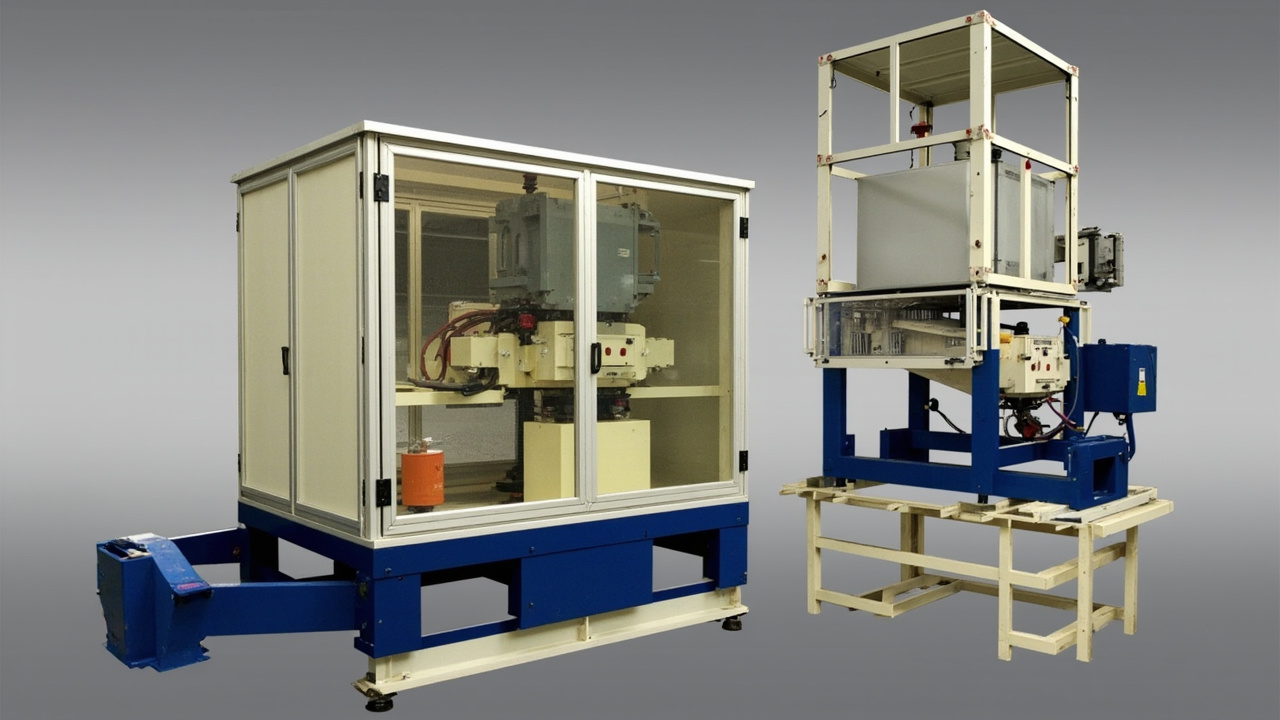
When isolation alone is insufficient, acoustic enclosures provide the most powerful noise reduction available. A well-designed enclosure can reduce total feeder noise by 15–25 dB(A), bringing even the loudest installations below regulatory limits.
An effective acoustic enclosure has three functional layers:
Mass barrier: The outer shell, typically 1.5–2 mm steel or aluminum, reflects sound energy back into the enclosure. Mass is critical — lightweight panels simply vibrate and re-radiate noise. The panel resonant frequency must be well below the feeder operating frequency to prevent sympathetic vibration.
Absorption layer: The interior surface is lined with acoustic foam, mineral wool, or fiberglass batting that converts sound energy to heat through frictional losses. The absorption coefficient must be high across the frequency range of interest. Open-cell polyurethane foam works well for mid and high frequencies; denser mineral wool is needed for low-frequency mechanical noise.
Sealing and access: Gaps, seams, and openings are the enemy of enclosure performance. A 1% open area can reduce enclosure effectiveness by 10 dB or more. All joints must be gasketed. Access doors should have acoustic seals and latches that maintain closure force. Viewing windows should use laminated acoustic glass, not standard safety glass. Cable and pipe penetrations require flexible grommets or packed seals.
Ventilation is a design challenge. The electromagnetic coil and controller generate heat that must be dissipated, but ventilation openings are acoustic leaks. The solution is a labyrinthine vent path lined with absorption material, or a forced ventilation system with acoustic baffles and low-noise fans. In extreme cases, remote mounting of the controller outside the enclosure eliminates both heat and electrical penetration issues.
Huben Automation designs custom acoustic enclosures matched to specific bowl sizes and production requirements. Enclosures can be retrofitted to existing feeders or specified as part of new systems. For more details on enclosure design, see our dedicated article on acoustic enclosures for vibratory feeders.
Drive Tuning and Frequency Optimization
Every vibratory feeder has a natural resonant frequency determined by the mass of the bowl and the stiffness of the spring pack. When operated at resonance, the feeder achieves maximum vibration amplitude with minimum input power. Running off-resonance requires higher controller output, which increases noise, heat, and mechanical stress.
Proper tuning is therefore a noise reduction measure as well as a performance optimization. A detuned feeder may require 50% more power to achieve the same feed rate, with a corresponding increase in mechanical noise. Retuning to resonance can reduce noise by 3–6 dB(A) while simultaneously improving feed rate and extending component life.
The tuning process requires a variable frequency controller:
- Start with a clean, properly filled bowl and the part to be fed.
- Set amplitude to approximately 50% of maximum.
- Slowly sweep frequency through the expected range (typically 45–65 Hz for 50 Hz mains, 90–130 Hz for 100/120 Hz systems).
- Observe part movement and listen to the feeder sound. At resonance, parts will move most vigorously and the mechanical sound will have a clear, pure tone rather than a strained quality.
- Fine-tune frequency in 1 Hz increments to find the point of maximum feed rate at minimum controller output.
- Record the optimal frequency and set controller limits to prevent drift.
Spring condition directly affects resonant frequency. As springs fatigue, their stiffness decreases and the resonant frequency drops. A feeder that was perfectly tuned two years ago may now be operating several hertz above resonance. Preventive spring replacement every 18–24 months maintains tuning and prevents the gradual noise increase that accompanies spring aging.
Amplitude optimization also matters. Many feeders are set to vibrate harder than necessary, either because the original setup was conservative or because operators increase amplitude when feed rate drops due to other causes. Reducing amplitude to the minimum level that maintains reliable feeding typically reduces noise by 2–4 dB(A) with no production impact. The key is to reduce amplitude gradually while monitoring feed rate, stopping at the point just before feeding becomes unreliable.
Material Selection and Surface Treatments
The materials of the bowl and tooling significantly influence part collision noise. A bare stainless steel bowl feeding steel parts is among the loudest possible combinations. Strategic material selection and surface treatments can reduce collision noise by 5–15 dB(A).
Polyurethane coatings: Applying a 1–3 mm layer of polyurethane to the bowl track is the most common noise reduction treatment. Polyurethane cushions part impacts, converting sharp metallic rings to dull thuds. It also protects the bowl from wear and protects parts from scratching. Typical noise reduction: 5–10 dB(A). Lifespan: 1–3 years depending on part abrasiveness and throughput. Huben applies polyurethane coatings as standard on most feeders and offers re-coating services for worn bowls.
Rubber linings: For maximum noise reduction, rubber or neoprene linings provide superior damping compared to polyurethane. They are softer and absorb more impact energy. The trade-off is reduced wear life — rubber degrades faster than polyurethane, especially with oily parts or in high-temperature environments. Typical noise reduction: 8–15 dB(A). Best for light parts and lower-volume applications.
Brush or flock coatings: A velour-like surface applied to the track virtually eliminates metallic contact noise. Parts slide on thousands of fine fibers rather than contacting metal directly. This is the preferred solution for extremely noise-sensitive applications such as medical device cleanrooms or laboratories. Typical noise reduction: 10–18 dB(A). Limitations include reduced durability and more frequent replacement.
Tooling material substitution: Steel tooling at contact points can be replaced with engineering plastics such as Delrin, nylon, or polyurethane. This eliminates metal-on-metal impacts at the highest-stress locations — orientation selectors, wipers, and return zones. The noise reduction is localized but significant at the operator position if the tooling is near the discharge point.
| Surface treatment | Noise reduction | Wear life | Best application | Relative cost |
|---|---|---|---|---|
| Polyurethane coating (1–3 mm) | 5–10 dB(A) | 1–3 years | General industrial metal parts | Low |
| Rubber lining (3–5 mm) | 8–15 dB(A) | 6–18 months | Light parts, noise-critical environments | Low–medium |
| Brush/flock coating | 10–18 dB(A) | 3–12 months | Delicate parts, cleanrooms, labs | Medium |
| Plastic tooling inserts | 3–8 dB(A) localized | 6–24 months | High-impact tooling points | Low |
| Teflon coating | 2–5 dB(A) | 1–2 years | Parts with adhesive tendency | Medium |
| No treatment (bare steel) | Baseline | 3–10 years | Rugged parts, noise not a concern | None |
Operational Controls: Fill Level and Part Density
Operational parameters have a surprisingly large effect on noise level. A feeder that is quiet at one fill level may be significantly louder when overfilled or underfilled.
Bowl fill level: An overfilled bowl contains more parts colliding simultaneously, increasing part-on-part noise. It also overloads the drive, which may buzz or rattle as it struggles to move the excess mass. The optimal fill level — typically one-third to one-half of bowl volume — minimizes noise while maintaining reliable feeding. Automated hopper level control that maintains consistent fill is therefore a noise control measure as well as a productivity enhancement.
Part load per cycle: Reducing the number of parts on the track at any moment reduces collision frequency. This can be achieved by metering parts onto the track with a wiper or gate, or by using a bowl design that naturally limits track loading. The trade-off is reduced maximum throughput, but for many applications the throughput reduction is modest while the noise reduction is significant.
Vibration amplitude: As noted in the tuning section, excessive amplitude increases noise through multiple mechanisms: greater part throw height increases impact energy, the drive operates at higher power with more mechanical noise, and parts bounce more vigorously against tooling. Optimizing amplitude is free and effective.
Feeding schedule: In some applications, intermittent feeding can replace continuous operation. A feeder that runs only when the downstream buffer is empty may operate 50–70% of the time rather than 100%, reducing time-weighted noise exposure proportionally. This requires buffer storage and sensor integration but can be the most cost-effective noise control where continuous feeding is not strictly necessary.
Case Studies: Real-World Noise Reduction Projects
Case Study 1: Automotive fastener feeding at 92 dB(A)
An automotive supplier operated twelve vibratory bowl feeders feeding hardened steel fasteners to assembly stations. Operator exposure averaged 92 dB(A), requiring hearing protection and triggering OSHA engineering control requirements. The facility needed to reduce levels below 85 dB(A) to eliminate the hearing conservation program burden.
Huben engineers conducted frequency analysis and determined that part collision noise dominated at 4–8 kHz, while mechanical drive noise contributed a 100 Hz fundamental with harmonics. The solution combined three measures: polyurethane bowl coating (–8 dB), elastomer isolation pads under all feeders (–4 dB), and amplitude optimization through retuning (–3 dB). Total reduction: 15 dB(A), bringing operator exposure to 77 dB(A). Implementation cost was recovered in 14 months through eliminated hearing protection supplies, reduced audiometric testing, and improved operator retention.
Case Study 2: Medical device cleanroom at 78 dB(A)
A medical device manufacturer needed to feed plastic components in an ISO Class 7 cleanroom where the background level from HVAC was 55 dB(A). The vibratory feeder added 23 dB(A), creating an environment that operators found stressful and that interfered with verbal communication during procedure verification.
Because cleanroom restrictions limited the use of porous acoustic foam, Huben designed a stainless steel enclosure with smooth interior surfaces for wipe-down compatibility. Ventilation used HEPA-filtered laminar flow to prevent particulate generation. Isolation mounts decoupled the feeder from the cleanroom floor. Inside the enclosure, the bowl was lined with a thin FDA-compliant polyurethane coating. The result: 18 dB(A) reduction to 60 dB(A), only 5 dB above background. The enclosure added $2,400 per feeder but was accepted as a necessary cost of cleanroom operation.
Case Study 3: Multi-story building structure-borne vibration
A precision electronics manufacturer on the second floor of a multi-tenant building received complaints from the ground-floor tenant about vibration and low-frequency noise. Measurements showed 68 dB(A) in the production area and 52 dB(A) in the space below — both within occupational limits but unacceptable for the building lease.
The solution required addressing structure-borne transmission rather than airborne noise. Huben replaced the existing rigid mounting with steel spring isolators selected for the specific feeder mass and floor stiffness. A flexible connection replaced the rigid discharge chute. Additional mass was added to the support frame to reduce its resonant response. These measures reduced downstairs noise to 38 dB(A), below ambient levels, at a cost of $800 per feeder.
Frequently Asked Questions About Feeder Noise Reduction
What is an acceptable noise level for a vibratory feeder?
For general industrial environments, target 75 dB(A) or lower at the operator position. This provides margin below the OSHA action level of 85 dB(A) and creates a comfortable working environment. For noise-sensitive areas such as cleanrooms, laboratories, or inspection stations, 65 dB(A) or lower may be required. The EU exposure action value of 80 dB(A) means European facilities should aim for 70–75 dB(A) to account for other noise sources on the factory floor. Huben measures and documents noise levels during factory acceptance testing to verify compliance with your specific requirements.
What is the cheapest way to reduce vibratory feeder noise?
The lowest-cost measures, in order, are: (1) optimize amplitude and tuning — free if you have a variable frequency controller; (2) reduce bowl fill to the minimum effective level — free operational change; (3) tighten all fasteners to eliminate rattling — labor only; (4) add elastomer isolation pads — $20–$100; (5) apply polyurethane bowl coating — $100–$500. These five measures combined can reduce noise by 10–18 dB(A) for under $600. Acoustic enclosures and alternative feeder technologies are more expensive but may be necessary for the most demanding applications.
Should I use an acoustic enclosure or bowl coating?
These are complementary rather than alternative solutions. Bowl coating reduces part collision noise at the source; the enclosure blocks whatever noise remains. For maximum reduction, use both. If budget limits you to one, choose based on the dominant noise source. If part collision noise dominates (metal parts in steel bowls, high throughput), start with coating. If mechanical drive noise dominates (large bowl, rigid mounting, resonant support), start with isolation mounts and consider enclosure. Huben provides noise source analysis as part of our engineering service to guide this decision.
Will reducing noise also reduce feed rate?
Not necessarily. Tuning optimization and amplitude reduction often improve feed rate while reducing noise. Bowl coatings may slightly reduce feed rate due to increased friction, but this is usually offset by the ability to run at higher amplitude without excessive noise. If throughput is critical, specify low-friction polyurethane formulations or thin coatings (1 mm rather than 3 mm). In cases where noise and throughput are fundamentally incompatible, Huben can recommend alternative feeder technologies such as step feeders or flexible vision systems that achieve comparable rates with lower noise.
Do I need to measure noise levels myself, or can I rely on manufacturer specifications?
Manufacturer specifications are useful for comparison and initial planning but cannot replace on-site measurement. The actual noise level depends on part material, bowl coating condition, mounting, surrounding structures, and other equipment. Regulatory compliance is based on operator exposure, which is determined by measurement at the actual operator position during normal operation. Huben provides factory noise measurements with our equipment, but we recommend that customers conduct their own workplace noise assessments using a calibrated Class 2 sound level meter to ensure compliance with local regulations.
When should I consider an alternative feeder type instead of noise-reducing a vibratory feeder?
Consider alternatives when: (1) noise reduction requirements exceed 25 dB(A) — difficult to achieve with vibratory technology regardless of treatment; (2) the application is in a noise-critical environment such as a hospital, laboratory, or residential-adjacent facility; (3) part delicacy makes vibratory feeding unsuitable regardless of noise; (4) the total cost of noise reduction measures approaches the cost of a quieter alternative. Step feeders, centrifugal feeders, and flexible vision systems all operate at significantly lower noise levels. Huben provides unbiased technology recommendations based on your part characteristics, throughput requirements, and noise constraints.
Conclusion: Engineering Quiet into Your Feeding Systems
Vibratory feeder noise is not an inevitable cost of automated feeding. It is an engineering problem with engineering solutions. The most effective approach combines multiple strategies: vibration isolation to prevent structure-borne transmission, acoustic enclosures to block airborne sound, surface treatments to reduce part collision noise, and proper tuning to minimize drive energy.
The investment in noise reduction pays returns in regulatory compliance, operator health and retention, product quality, and facility flexibility. A feeder that meets 75 dB(A) today can be installed in any production environment without acoustic constraints. A feeder at 90 dB(A) limits layout options, requires personal protective equipment, and creates liability exposure.
Huben Automation designs noise control into every feeder we manufacture. Standard features include polyurethane bowl coatings, elastomer isolation mounts, and variable frequency controllers for tuning optimization. Optional upgrades include custom acoustic enclosures, rubber or brush linings, and alternative feeder technologies for the most demanding applications.
If noise from your vibratory feeders is creating compliance risks or operational problems, contact Huben Automation for a noise assessment and reduction proposal. With 20+ years of experience, ISO 9001 certification, and factory-direct pricing, we deliver feeding systems that perform quietly and reliably.
Bereit, Ihre Produktion zu automatisieren?
Erhalten Sie eine kostenlose Beratung und ein detailliertes Angebot innerhalb von 12 Stunden von unserem Ingenieurteam.