Vibratory Feeder for Rubber Seals: Overcoming Friction, Nesting, and Stickiness

Rubber seals are among the hardest parts to feed reliably
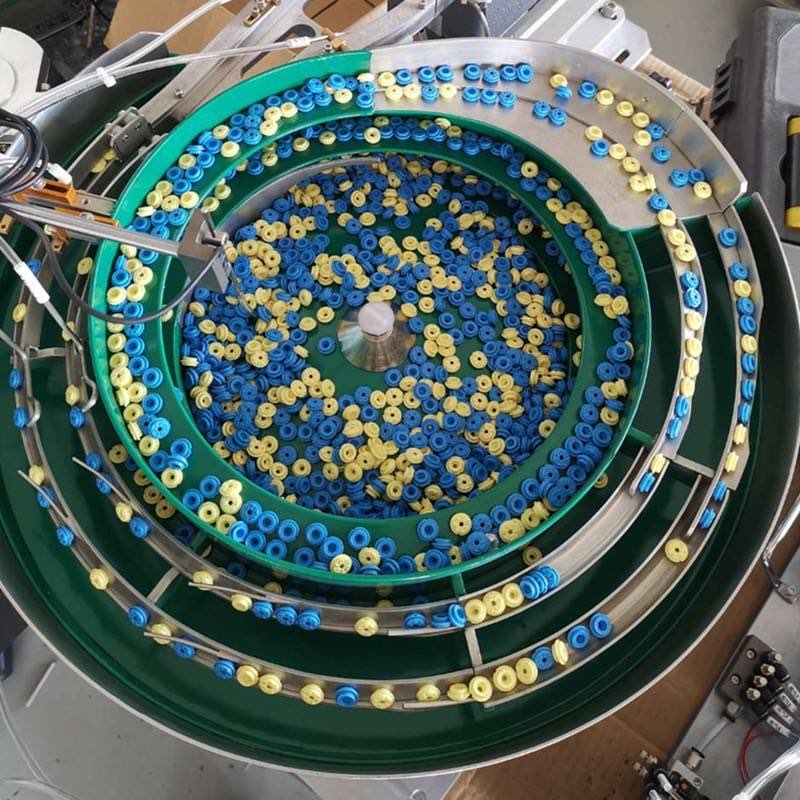
Rubber seals, O-rings, gaskets, and similar elastomer components look simple on a drawing. In a vibratory feeder, they become some of the most frustrating parts to handle. High friction slows movement along the track. Flexible geometry makes orientation unpredictable. Surface tackiness causes parts to cling together or stick to the bowl wall. And nesting — where one seal fits inside another — turns a bulk load into a stack of interlocked rings that the feeder cannot separate.
These problems are not edge cases. They are the default behavior for most rubber seal feeding applications. A feeder that runs metal fasteners at 200 ppm may deliver rubber seals at 40-60 ppm with frequent operator intervention, or it may fail to run at all without specific design adaptations.
This article covers the engineering strategies that make rubber seal feeding work: anti-nesting tooling, low-friction track coatings, amplitude and frequency tuning for elastomers, lubrication methods, and the decision between bowl feeders and flexible feeders for rubber parts. For broader context on soft-material handling, see our O-ring feeding system guide and rubber parts feeding guide.
The four core challenges of rubber seal feeding
Understanding why rubber seals misfeed requires looking at four distinct mechanisms. Each one affects feeder behavior independently, and together they compound into the unreliable performance that many production teams experience.
High friction and slow track movement
Elastomer materials have coefficients of friction 3-10 times higher than steel or hard plastics. NBR (nitrile) rubber has a static coefficient of friction against stainless steel in the range of 0.5-1.2, compared to 0.15-0.3 for steel-on-steel. This means rubber seals resist the micro-throw motion that vibratory feeders rely on to advance parts along the track.
In practice, seals move slowly, bunch up at the bottom of the bowl, and fail to climb the track at the rate the feeder was designed for. Increasing vibration amplitude to compensate often makes the problem worse — the parts bounce erratically instead of advancing smoothly, and orientation tooling cannot capture them consistently.
Nesting and interlocking
Nesting is the single most distinctive problem in rubber seal feeding. O-rings, quad rings, and lip seals are designed to fit around shafts and into grooves — which means they also fit around and into each other. When bulk-loaded into a bowl, seals nest concentrically, forming stacks that the feeder cannot separate through vibration alone.
Nested pairs or triples travel as a single unit. They defeat orientation tooling because the combined geometry does not match any single-part profile. They jam in selectors and escapements. And they create false counts at the discharge, where a "single" part is actually two or three stuck together.
Surface tackiness and sticking
Many rubber compounds exhibit surface tack — a slight adhesion that causes parts to cling to each other or to the feeder surface. This is especially pronounced with fresh NBR and silicone parts that have not been dusted with talc or treated with mold release. Tackiness causes parts to travel in pairs, stick to the bowl wall instead of returning to the track, and resist separation at the entry zone.
Temperature and humidity amplify the effect. A feeder that runs acceptably at 20 °C may become unreliable at 28 °C because the elastomer surface softens slightly and tack increases. This is one reason rubber seal feeders often behave differently from shift to shift or season to season.
Flexible geometry and orientation instability
Rubber seals deform under their own weight and under the vibration forces in the bowl. An O-ring that should present as a flat circle may arrive at the discharge twisted, folded, or compressed. Lip seals and gaskets with asymmetric profiles can flex enough to pass through orientation tooling in the wrong position, only to spring back into their correct shape after the tooling point.
This makes orientation yield unpredictable. A mechanical selector that works 99% of the time on a rigid part may drop to 85-90% on a flexible seal of the same nominal geometry, because the part deforms enough during the selection event to pass through in an incorrect state.
| Challenge | Primary symptom | Root cause | Effective countermeasure |
|---|---|---|---|
| High friction | Slow or stalled track movement | Elastomer-on-metal COF 3-10× steel | Low-friction coating + amplitude tuning |
| Nesting | Interlocked part pairs at discharge | Concentric geometry allows stacking | Anti-nesting tooling + controlled bowl fill |
| Surface tack | Parts cling together or to bowl wall | Adhesive surface energy of elastomer | Dry PTFE spray + open entry geometry |
| Flexible geometry | Low orientation yield | Part deforms through tooling | Wider tooling tolerances + vision verification |
Anti-nesting tooling design
Preventing nesting is the first engineering priority for any rubber seal feeder. If parts enter the track already nested, no amount of downstream tooling will fix the problem. The separation must happen at the bowl entry, before parts reach the orientation zone.
Entry zone design
The entry zone — the transition from the bowl floor to the rising track — is where nesting must be broken. Several proven strategies exist:
- Staggered riser plates: Instead of a single track edge, use two or three stepped riser plates at slightly different heights. A nested pair encounters the first step, and the inner seal is more likely to separate because the outer seal catches the edge first. This is the most widely used anti-nesting feature for O-rings.
- Center cone with radial slots: A raised cone at the bowl center with radial slots allows single seals to pass but forces nested stacks to separate as they encounter the slot edges. Effective for seals from 10 mm to 80 mm OD.
- Air-jet separation: A directed air jet at the entry zone blows the inner seal out of a nested pair. This works well for lightweight seals under 5 grams but requires consistent air supply and adds noise.
- Reduced bowl fill level: Keeping the bowl fill to 20-30% of capacity (versus 60-70% for metal parts) reduces the pressure that forces seals into nested configurations. This is the simplest change and often the most effective, though it reduces unattended runtime.
Track geometry for seals
Once separated, seals need a track geometry that discourages re-nesting. A V-groove track is standard for O-rings because the V-shape cradles the ring cross-section and prevents one ring from sitting on top of another. The groove angle should be 90-120°, and the depth should be 0.6-0.8 times the seal cross-section diameter.
For flat gaskets and lip seals, a flat track with a center ridge or raised edge works better. The ridge prevents the seal from flipping and creates a consistent running position that downstream tooling can target.
Low-friction track coatings for rubber
Coating selection is the second critical design decision for rubber seal feeders. The coating must reduce friction enough for parts to advance smoothly, withstand the abrasion of continuous rubber contact, and not transfer material to the part surface.
| Coating type | COF vs. rubber | Wear life | Best application | Limitations |
|---|---|---|---|---|
| PTFE (Teflon) | 0.04-0.10 | 3-6 months | Low-speed, low-volume, maximum slip | Wears quickly under continuous operation |
| Hard chrome | 0.12-0.20 | 12-24 months | High-volume production, oily parts | Expensive, requires rework at wear-through |
| Polyurethane (PU) | 0.25-0.40 | 8-14 months | General rubber seal feeding | Higher friction than PTFE or chrome |
| Nylon (PA6) insert | 0.15-0.25 | 6-12 months | Tooling contact points, replaceable | Limited to localized areas |
| Electroless nickel + PTFE | 0.08-0.15 | 10-18 months | Best balance of slip and durability | Higher initial cost |
For most production rubber seal feeders, electroless nickel with PTFE particles (Ni-PTFE) offers the best practical balance. The nickel matrix provides hardness and wear resistance, while the embedded PTFE particles create a self-lubricating surface that reduces friction against rubber. The coating lasts 10-18 months in continuous operation and can be reapplied during scheduled maintenance.
Hard chrome is the second choice for high-volume applications where the parts carry oil or lubricant that already reduces friction. Chrome is extremely durable but provides less slip on dry rubber than Ni-PTFE. It is also more expensive to apply and repair.
PTFE-only coatings provide the lowest friction but wear through in 3-6 months under production conditions. They are best reserved for prototype feeders, low-volume applications, or as a temporary measure while a more durable coating is being specified.
Amplitude and frequency settings for rubber
Rubber seals require different vibration parameters than metal parts. The goal is enough energy to overcome friction and advance parts, but not so much that parts bounce erratically or deform during orientation.
- Amplitude: Reduce to 50-70% of the setting used for metal parts of similar size. For a 30 mm O-ring, typical amplitude is 0.8-1.2 mm peak-to-peak, compared to 1.5-2.5 mm for an M6 steel screw.
- Frequency: Most rubber seal feeders operate at 50-60 Hz. Lower frequencies (25-30 Hz) can work for large, heavy seals but reduce feed rate. Higher frequencies increase bounce and are generally counterproductive.
- Controller tuning: Use a controller with fine amplitude adjustment (1% increments or better). Rubber seal behavior is sensitive to small amplitude changes — a 5% shift can be the difference between stable feeding and constant jamming.
- Ramp-up behavior: Program a slow ramp-up (2-3 seconds) rather than instant start. Sudden vibration onset causes rubber parts to jump and scatter, which increases nesting at startup.
The key principle: rubber seal feeders should run at the lowest amplitude that maintains the required feed rate. Any additional amplitude beyond that threshold creates problems without improving output.
Lubrication strategies for rubber seal feeding
Lubrication can dramatically improve rubber seal feeding performance, but it must be applied carefully. The wrong lubricant contaminates parts, attracts dust, or degrades the elastomer over time.
Dry PTFE spray is the most widely accepted lubrication method for rubber seal feeders. It deposits a thin PTFE film on the track surface that reduces friction without leaving a wet residue. PTFE spray can be applied periodically during operation — typically every 2-4 hours — and does not affect most elastomer materials. It is also compatible with downstream processes because the film is dry and minimal.
Silicone spray provides excellent slip but leaves a wet residue that can interfere with downstream bonding, sealing, or inspection processes. It also attracts dust and requires more frequent cleaning. Use silicone spray only when the downstream process explicitly tolerates it.
Talc or cornstarch dusting on the parts themselves (not the track) reduces surface tack and nesting tendency. This is a common practice in seal manufacturing — many O-rings are shipped with a light talc coating. If your parts arrive uncoated, a light dusting before loading the bowl can improve feeding consistency significantly.
Water-mist systems are used in some food-grade applications where dry lubricants are not permitted. A fine water mist on the track surface reduces friction temporarily but requires drainage and corrosion protection for the bowl structure.
When to choose a bowl feeder vs. a flexible feeder for rubber seals
The choice between a dedicated bowl feeder and a vision-guided flexible feeder depends on part variety, volume, and how much the rubber compound varies between production lots.
Bowl feeders are the right choice when the line runs a single seal size or a small family of similar sizes at volumes above 60 ppm. A well-designed bowl with anti-nesting tooling and the correct coating will outperform a flexible feeder on speed, consistency, and cost per part. The investment pays back quickly on dedicated lines.
Flexible feeders become attractive when the line changes among multiple seal sizes, when the part geometry is too variable for reliable mechanical orientation, or when lot-to-lot material variation makes fixed tooling unreliable. Flexible feeders handle nesting differently — parts are spread on a vibrating platform and identified individually by camera, so nested pairs are simply not picked. This eliminates the most persistent bowl feeder problem entirely.
The trade-off is speed. Flexible feeders typically deliver 15-40 ppm for rubber seals, compared to 60-150 ppm for a well-tuned bowl. On mixed-model lines where changeover time matters more than peak speed, the flexible feeder often wins on total effective throughput.
| Factor | Bowl feeder | Flexible feeder |
|---|---|---|
| Feed rate (rubber seals) | 60-150 ppm | 15-40 ppm |
| Anti-nesting approach | Mechanical (entry zone tooling) | Inherent (individual pick) |
| Changeover time | 15-45 minutes (tooling swap) | 1-5 minutes (recipe change) |
| Lot variation tolerance | Low — fixed tooling | High — vision adapts |
| Surface protection | Coating-dependent | Minimal contact |
| Best for | High-volume, single-part lines | Mixed-model, variable lots |
Key takeaways
- Address nesting at the entry zone first. No amount of downstream tooling fixes nested parts. Staggered risers, center cones, and controlled bowl fill are the primary defenses.
- Select coating for the specific rubber compound. Ni-PTFE for general production, hard chrome for oily parts, PTFE-only for low-volume or prototype use.
- Run at the lowest effective amplitude. Rubber seals need less vibration energy than metal parts, and excess amplitude creates more problems than it solves.
- Use dry PTFE spray as the default lubricant. It reduces friction without contaminating parts or degrading elastomers, and it is compatible with most downstream processes.
- Choose flexible feeders for mixed-model lines. The inherent anti-nesting behavior and rapid changeover outweigh the speed penalty when the line runs multiple seal sizes.
Frequently Asked Questions
Can I use a standard bowl feeder for rubber seals without modification?
A standard bowl feeder designed for metal parts will likely move rubber seals, but with serious problems: nesting at the entry, slow track movement from high friction, and parts sticking to the bowl wall. The modifications needed — anti-nesting tooling, low-friction coating, and amplitude reduction — are not optional for production use. They are the difference between a feeder that technically runs and one that runs reliably without constant operator attention.
How do I prevent O-rings from nesting inside each other?
The most effective approach combines three strategies: keep the bowl fill level low (20-30% of capacity), install staggered riser plates at the track entry to mechanically separate nested pairs, and apply a light talc dusting to the parts before loading. Air-jet separation at the entry zone provides an additional layer of protection for critical applications. No single method is 100% effective alone — the combination is what makes it work.
What bowl coating lasts longest for rubber seal feeding?
Hard chrome provides the longest wear life (12-24 months) but does not offer the lowest friction on dry rubber. Electroless nickel with PTFE particles (Ni-PTFE) provides the best practical balance of slip and durability at 10-18 months. Pure PTFE coatings have the lowest friction but wear through in 3-6 months. For most production applications, Ni-PTFE is the recommended choice.
Does temperature affect rubber seal feeding performance?
Yes, significantly. Elastomer surface tack increases with temperature, and friction behavior changes as the material softens. A feeder tuned at 20 °C may become unreliable at 28 °C or above. For environments with temperature variation, specify a controller with fine amplitude adjustment so operators can compensate. Also validate feeder performance at the highest expected operating temperature, not just at room temperature.
When is a flexible feeder better than a bowl feeder for rubber seals?
A flexible feeder is the better choice when the line runs multiple seal sizes (3+ part numbers), when lot-to-lot material variation makes fixed tooling unreliable, or when the required feed rate is below 40 ppm. Flexible feeders eliminate nesting inherently because each part is picked individually by vision. They also reduce changeover time from 15-45 minutes to 1-5 minutes. The trade-off is lower maximum speed.
Is dry PTFE spray safe for all rubber compounds?
Dry PTFE spray is compatible with the vast majority of sealing elastomers including NBR, EPDM, silicone, fluorocarbon (FKM), and neoprene. It is inert, leaves minimal residue, and does not degrade elastomer properties. However, always verify compatibility with the specific compound and downstream process requirements. Some bonding or coating operations downstream may be sensitive to even trace PTFE residue on the part surface.
Ready to Automate Your Production?
Get a free consultation and detailed quote within 12 hours from our engineering team.