Step Feeder vs Vibratory Feeder: 8 Criteria to Decide (2026)

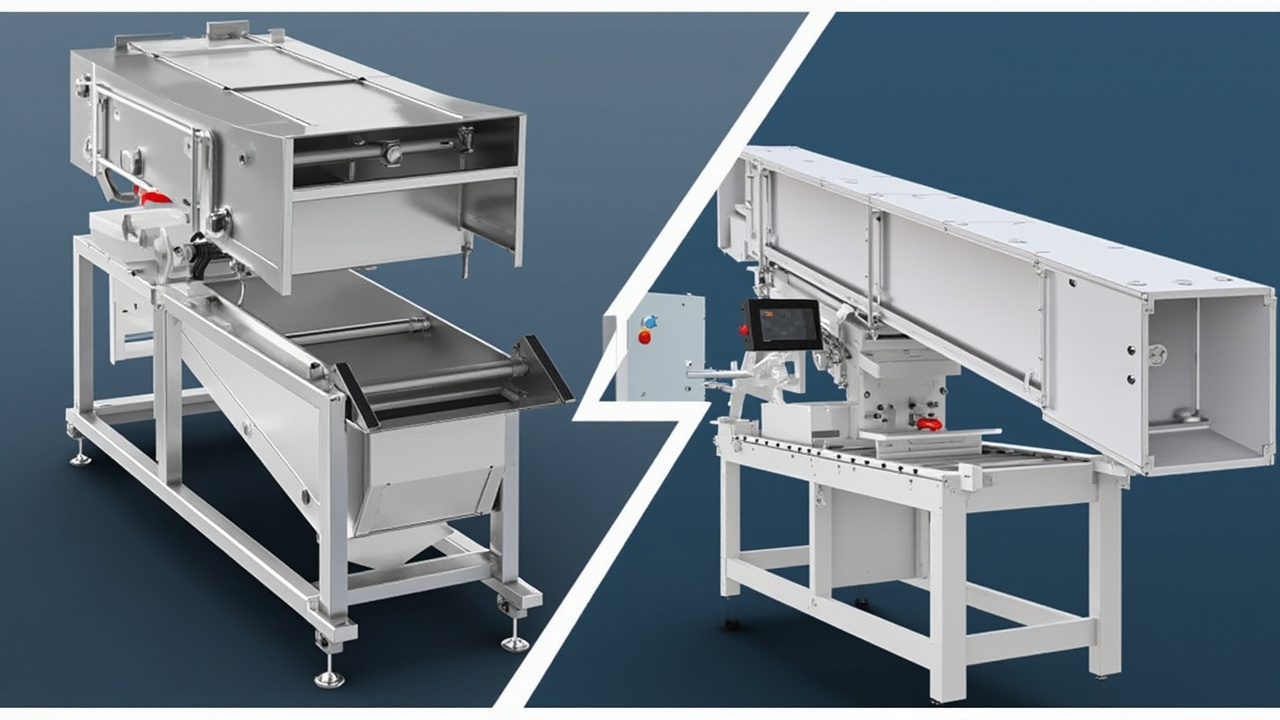
Step Feeder vs Vibratory Feeder: Two Very Different Approaches
Step feeders and vibratory bowl feeders both move bulk parts to an oriented discharge, but they get there through fundamentally different physics. A step feeder lifts parts upward in discrete mechanical steps. A vibratory feeder uses electromagnetic vibration to walk parts up a spiral track. Pick the wrong one for your line and you will spend twice on rework, redesign, and noise mitigation. This guide gives engineers eight concrete decision criteria, a decision tree, and realistic price ranges so the choice can be made before the RFQ goes out.
How Each Technology Works
Step Feeder: Mechanical Lift
A step feeder consists of a deep hopper, a stack of reciprocating horizontal platforms (the "steps"), and a final discharge ledge. The steps move up and down through a cam or servo drive. Parts that come to rest correctly on a step rise to the next level; parts not seated slide back into the hopper. Because the lift is intermittent and parts settle by gravity between cycles, the bulk of the part lot is at rest most of the time. There is no continuous high-frequency excitation transmitted into part bodies.
Typical step feeders deliver 20-200 parts per minute. Step heights commonly range from 5 mm to 60 mm. The hopper is sized to hold 30-90 minutes of production parts, often integrated into the same frame as the lift. See our step feeder design guide for specifications.
Vibratory Bowl Feeder: Electromagnetic Vibration
A vibratory bowl feeder uses an electromagnetic coil and tuned spring system to vibrate a spiral-tracked bowl at line frequency (50/60 Hz) or half-line (25/30 Hz). The vibration creates a series of micro-jumps that walk parts up the spiral. Tooling cut into the track (selectors, wipers, air jets, cutouts) rejects mis-oriented parts back into the bulk pile, allowing only correctly oriented parts to exit. Throughput ranges from 200 to over 1,000 parts per minute depending on bowl diameter and part geometry.
Because every part in the bowl experiences continuous vibration, surface contact with the track and with neighboring parts is constant. This is the source of both the vibratory bowl's strength (relentless reorientation of every part) and its weakness (surface wear on coated, painted, or polished components).
8-Criteria Side-by-Side Comparison
| # | Criterion | Step Feeder | Vibratory Bowl Feeder |
|---|---|---|---|
| 1 | Throughput (typical) | 20-200 ppm | 200-1,000+ ppm |
| 2 | Vibration on parts | None continuous; gentle drop between steps | Continuous 25-60 Hz on every part in the bowl |
| 3 | Noise level (1 m, A-weighted) | 50-65 dB | 70-85 dB; 90+ for large heavy bowls |
| 4 | Footprint per 1,000-part buffer | 0.4-0.7 m² (vertical hopper) | 0.6-1.2 m² (bowl + external hopper) |
| 5 | Equipment cost (turnkey, USD) | $8,000-$22,000 | $3,500-$12,000 |
| 6 | Changeover time | 20-60 min (mechanical step adjustment) | 30 min - 4 hr (tooling change or re-tune) |
| 7 | Fragile / coated parts | Excellent — minimal surface contact | Risk of coating wear, polish loss, micro-scratches |
| 8 | Orientation accuracy (multi-feature parts) | Moderate — relies on natural seating | High — multi-stage tooling for complex geometry |
When a Step Feeder Always Wins
Some applications are so well-suited to step feeders that vibratory bowls cannot compete on a total-system basis:
- Coated and painted parts — automotive trim, powder-coated hardware, anodized fasteners. The surface specification often disqualifies vibratory contact entirely.
- Glass and ceramic — chipping risk under sustained vibration. Step feeders set the part down between cycles.
- Large or heavy parts above 100 g — vibratory bowls have to be oversized to lift and re-orient heavy parts, and the resulting bowl gets loud and expensive.
- Noise-sensitive cells — operator workstations, medical clean assembly, cells adjacent to office space. 15-20 dB delta over a vibratory feeder usually eliminates the need for an acoustic enclosure.
- Low to medium throughput (under 200 ppm) — when downstream cycle time does not require 500+ ppm, the gentleness and quietness of a step feeder is a free upgrade.
- High part-to-part variation — flexible step heights and adjustable platforms tolerate dimensional drift better than vibratory tooling cut for one nominal size.
When a Vibratory Bowl Feeder Always Wins
Equally, some applications belong to vibratory bowls:
- High throughput (200+ ppm) — most assembly lines for fasteners, electronics, and packaging.
- Small parts under 5 mm — step feeders cannot reliably lift sub-gram parts; they jam on the step shoulders.
- Multi-axis orientation — when a part has to leave the bowl with a slot facing forward, a notch up, and a flat against the track, only multi-stage vibratory tooling can do this in a single device.
- Cost-sensitive simple parts — hex nuts, washers, plain pins. A $4,000 vibratory bowl beats a $12,000 step feeder on payback for any standard fastener.
- Existing line infrastructure — when the cell already runs vibratory bowls and shares spare parts, the marginal cost of one more bowl is the lowest option.
Decision Tree: Pick in Under a Minute
- Is the part surface coated, painted, polished, or otherwise damage-sensitive? Yes → step feeder. No → continue.
- Is the part heavier than 100 g or larger than 80 mm in any dimension? Yes → step feeder. No → continue.
- Does downstream cycle time require more than 250 ppm? Yes → vibratory bowl feeder. No → continue.
- Does the part require multi-axis orientation (more than 2 features)? Yes → vibratory bowl feeder. No → continue.
- Is the cell next to an operator workstation, office, or noise-controlled environment (under 75 dB)? Yes → step feeder (or vibratory + acoustic enclosure). No → continue.
- Is upfront capital constrained (budget under $5,000)? Yes → vibratory bowl feeder. No → step feeder is viable.
Most lines reach a clear answer within 3-4 questions. When the decision tree gives a tie (it sometimes does for coated fasteners running at 200-300 ppm), run a feed trial with samples on both technologies before specifying.
When to Combine Both: Hybrid Configurations
The two technologies are not exclusive. Several common production patterns deliberately combine them:
Step Hopper + Vibratory Inline Track
For parts that are easy to orient but cannot tolerate prolonged vibration, a step feeder serves as a gentle bulk supply, dropping pre-sorted parts onto a short vibratory inline track for final spacing and presentation. The vibratory exposure is reduced from 30-60 seconds in a bowl to 2-5 seconds on a track. This is common for painted automotive caps, anodized aluminum fasteners, and decorated cosmetic closures.
Vibratory Bowl + Step Recirculation
For high-throughput lines where the bowl is the orientation engine but a deep hopper is needed for autonomous run time, a step feeder lifts parts from a floor-level bulk hopper into the bowl. This separates "where parts wait" (the quiet step hopper) from "where parts are oriented" (the vibratory bowl), keeping noise contained and bowl size minimal.
Centrifugal Disc + Step Hopper
Less common but useful for symmetrical high-speed parts: a step feeder feeds a centrifugal disc that runs at 1,000+ ppm. Read our centrifugal feeder guide for selection between centrifugal and vibratory.
Realistic Price Ranges (2026)
| Configuration | Step Feeder Range | Vibratory Bowl Range |
|---|---|---|
| Standard, single part type | $8,000-$15,000 | $3,500-$7,000 |
| Custom tooling, complex orientation | $12,000-$22,000 | $6,000-$12,000 |
| Stainless steel, food-grade | $14,000-$25,000 | $7,000-$14,000 |
| Cleanroom (ISO 7) compliant | $18,000-$30,000 | $10,000-$18,000 |
| Noise enclosure (if needed) | Usually unnecessary | $2,000-$5,000 add-on |
| Spare tooling kit per additional part | $1,500-$3,000 (step shim adjustment) | $1,200-$4,000 (changeover bowl insert) |
Step feeders carry a 100-200% premium on equipment cost. The justification has to come from one of three places: damage prevention (coatings preserved), noise compliance (enclosure not needed), or labor savings (no rework on scratched parts). For lines where none of these apply, vibratory bowls are usually the right answer on pure ROI.
Buyer's Tip
If your team has been arguing about step vs vibratory for weeks, ship five sample parts to two suppliers — one specializing in step feeders, one in vibratory. Ask for a 2-minute video of each running at target rate. The video resolves disputes faster than any spec sheet.
Changeover and Multi-Part Considerations
Step feeders adapt to size variation by adjusting platform shim packs. A trained operator changes a step feeder over to a similar part in 20-40 minutes. Different part families (e.g., switching from a cap to a screw) require new platforms and may take 2-4 hours.
Vibratory bowls require either a complete bowl swap (with quick-change tooling, 30-60 minutes) or a track-tooling reconfiguration (2-4 hours). For lines that run 8-15 part numbers per day, multi-part vibratory systems with quick-change inserts are usually more flexible than step feeders. See our quick-change tooling guide.
Frequently Asked Questions
Can I use both a step feeder and a vibratory feeder on the same line?
Yes — hybrid systems are common. The step feeder typically handles bulk lifting and gentle pre-sorting; the vibratory feeder handles fine orientation or final track presentation. This pairing is especially common for coated parts that can tolerate brief vibration but not sustained vibratory bowl exposure. Expect total system cost of 1.3-1.6× a single-technology solution.
Is a step feeder the same as an elevator feeder?
Not exactly. Both lift parts vertically, but they differ in mechanism. A step feeder uses discrete reciprocating platforms (steps) to advance parts one level per cycle. An elevator feeder uses a continuous belt or chain with paddles or pockets to lift parts. Step feeders generally offer more gentle handling and more reliable orientation; elevators carry higher continuous throughput. For coated or fragile parts, a step feeder is usually the better lift technology.
How much quieter is a step feeder really?
Typically 15-20 dB(A) lower than an equivalent vibratory bowl. A 75 dB vibratory bowl drops to about 55-60 dB on a step feeder — the difference between "factory floor" and "office conversation." That margin often eliminates the need for acoustic enclosures, recovers the cost premium, and improves the operator workspace.
Which is cheaper to operate over 5 years?
For high-volume production of robust parts (fasteners, simple cylindrical components), vibratory bowls win on 5-year TCO by 20-40%. For coated, fragile, or large parts where vibratory feeding causes 1-3% scrap or rework, step feeders typically win on TCO because the avoided scrap exceeds the equipment premium. Calculate yield impact before deciding on cost alone.
Can step feeders handle parts smaller than 5 mm?
Generally not reliably. Step heights below 4 mm are difficult to manufacture with consistent precision, and small parts tend to nest between steps or roll off the platform edges. For sub-5 mm parts (micro-fasteners, SMD components, electronic terminals), a vibratory bowl with appropriate coating is the standard solution. See our micro-fastener feeding guide.
How to Move Forward
Run the decision tree, then validate with a sample feed trial. Ask suppliers for video evidence at target rate, and price the total system including any noise enclosure or operator-station modifications. Huben Automation builds both technologies and recommends one over the other based on your part and line, not what we happen to have inventoried. Send us 5-10 sample parts and we will return a feed video and a side-by-side cost analysis within two weeks.
Ready to Automate Your Production?
Get a free consultation and detailed quote within 12 hours from our engineering team.