Horizontal Motion vs Vibratory Feeders: 6 Sticky Material Cases (2026)

Sticky Material Feeding: Why the Wrong Technology Costs You
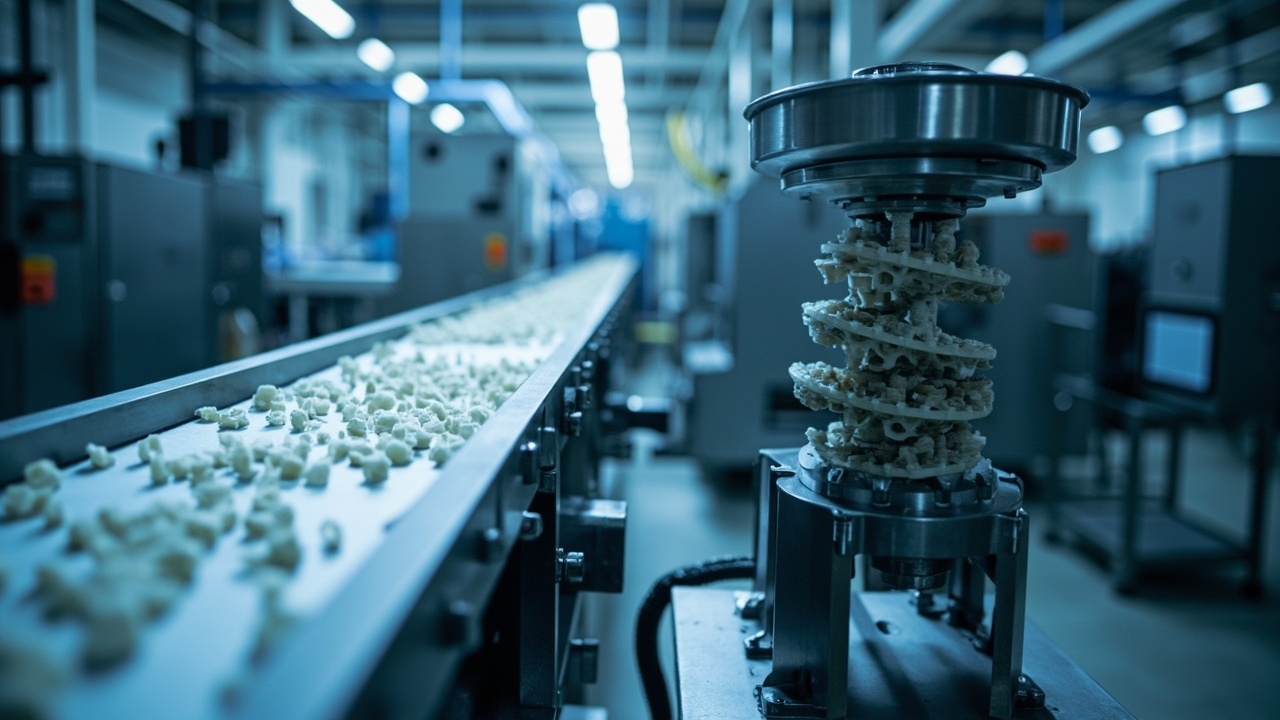
Sticky materials — chocolate-coated nuts, soft gummies, oily stamped parts, wet rubber seals, sugar-glazed cereals, dough pieces — defeat conventional vibratory feeders within minutes. Vibration drives sticky particles to bond with the track, smear orientation tooling, and cake into immovable masses at the bowl outlet. The losses are immediate: clogged tracks, manual cleaning every 30 minutes, product damage from over-handling, and yields that drift below 90%.
Horizontal motion conveyors (HMC), also called slide motion or differential motion conveyors, were developed in the late 1990s specifically to solve this problem. Instead of vibrating parts upward, HMCs slide them horizontally using a controlled forward-quick / backward-slow cycle. The product never leaves the surface. This guide compares HMCs and vibratory feeders for six sticky-material applications, with measured throughput, energy, and cost data — so engineers can pick the right tool before investing in equipment that doesn't fit the product.
How the Two Technologies Differ
Vibratory: Hop and Land
Vibratory feeders move parts via micro-jumps. The track vibrates at 25-60 Hz with a 1-3 mm amplitude pitched at a small angle to the horizontal. Each cycle: track moves up-and-forward, throws part upward briefly; track moves back-and-down, part lands forward of where it started. Net forward motion of 5-15 mm per second per cycle.
For sticky materials this is exactly the wrong motion. The part adheres to the track on the down-stroke; the next up-stroke breaks the bond, smearing residue. Within 5-10 minutes the residue accumulates, parts drag, and throughput collapses.
Horizontal Motion: Slow Forward, Fast Back
An HMC drives the entire pan in a horizontal asymmetric cycle. Forward stroke is slow (acceleration low enough that parts move with the pan via static friction). Return stroke is fast (acceleration high enough that parts cannot decelerate with the pan and slip forward). Net forward motion of 30-100 mm per second per cycle, with the product remaining flat on the pan throughout.
Because parts never leave the surface, sticky residue does not transfer in repeated cycles. The pan can be coated with PTFE or a hygienic stainless finish; cleaning happens with a sponge wipe instead of an ultrasonic bath.
Head-to-Head Comparison
| Parameter | Horizontal Motion Conveyor | Vibratory Feeder |
|---|---|---|
| Motion type | Asymmetric horizontal slide (no vertical lift) | Vertical hop with forward bias |
| Part-track contact | Continuous, never lifts | Intermittent, hops every cycle |
| Throughput per meter of pan | 30-100 m/min | 10-30 m/min for sticky; 30-60 m/min dry |
| Pan length range | 1-12 m typical, up to 30 m | 0.5-3 m typical for inline |
| Energy consumption (per kg/hr throughput) | 30-50% lower than vibratory at high mass | Higher, especially for heavy sticky loads |
| Noise level (1 m, A-weighted) | 55-65 dB | 72-85 dB |
| Sticky / wet material handling | Excellent | Poor — clogs in 5-15 min |
| Fragile food handling | Excellent — no impact | Moderate — repeated landings break delicate items |
| Cleaning time per shift | 5-10 min wipe | 20-45 min disassembly + ultrasonic on sticky lines |
| Equipment cost (3 m pan, sanitary) | $25,000-$60,000 | $8,000-$22,000 |
| Best for | Sticky, wet, fragile, oily, hygroscopic | Dry granular, free-flowing parts and food |
6 Sticky Material Application Cases
Case 1: Chocolate-Coated Nuts
A confectionery line packaging 800 kg/hr of chocolate-coated almonds onto multi-head weighers. The original vibratory feeder smeared chocolate within 8-12 minutes, requiring shutdown every hour for cleaning. Yields dropped 4-6% from cracked coatings.
Result with HMC: 11 m pan, 60 mm/s slide rate. Run time between cleanings extended from 60 minutes to 8-10 hours. Product damage reduced from 5% to under 0.5%. Throughput stabilized at 850 kg/hr (small increase from cleaner flow). Capital premium of about $35,000 paid back in under 14 months on yield improvement alone.
Case 2: Dough Pieces and Pastry Sheets
A bakery feeding 3 kg pizza dough portions to a sheeting line. Vibratory pans deformed the dough through repeated impact and flour transferred to the track within 20 minutes. Operators dusted the pan with flour every 30 minutes — adding cost and adding flour to the product specification.
Result with HMC: 4 m pan with PTFE-coated stainless surface. Dough portions slide without flour. The "no impact" motion preserved portion shape, reducing scrap from 8% to under 2%. Cleaning cycle moved from twice per shift to end-of-shift only.
Case 3: Oily Stamped Metal Parts
An automotive stamping line feeding oily small brackets (mass 30-80 g, residual oil 0.5-1.0 g per part) into a degreasing tunnel. Vibratory bowls collected oil at the bottom, glazed the bowl track, and required degreasing weekly.
Result with HMC: 6 m horizontal motion pan with drainage slots beneath. Oil drained continuously into a sump rather than accumulating on the track. Throughput rose from 280 ppm (vibratory, frequently cleaned) to 420 ppm (HMC, weekly wipe). See our oily parts feeding design guide for related considerations.
Case 4: Wet Rubber Seals (Post-Wash)
A medical device line feeding rubber seals after an aqueous wash, with surface moisture of 0.5-2.0% by mass. Vibratory bowls lost grip on wet rubber, throughput dropped 60%, and seals tangled at the discharge.
Result with HMC: 2.5 m pan with controlled airflow drying integrated above. Seals slid uniformly, drying as they progressed, and discharged at controlled spacing. Throughput recovered to 180 ppm and tangling stopped. The HMC plus airflow drying replaced a separate dryer station, saving floor space.
Case 5: Sugar-Coated Gummies and Soft Candies
A confectionery packaging line for sour-coated gummies. Vibratory feeding caused 3-7% product breakage and built up sugar dust on the track within 15 minutes, generating a fire-suppression alarm twice per week.
Result with HMC: 7 m pan with FDA-grade stainless. No impact, no breakage, sugar coating remained intact. Sugar dust generation dropped 80%, eliminating the fire suppression alarms. Throughput improved from 95 kg/hr (with cleaning interruptions) to 130 kg/hr stable.
Case 6: Hygroscopic Glazed Cereal
A breakfast cereal line feeding glaze-coated flakes into a bagging machine. The cereal absorbed humidity within 10-20 minutes on a vibratory pan, the glaze softened, and pieces clumped at the discharge.
Result with HMC: 5 m pan in a humidity-controlled enclosure. Slide motion plus controlled atmosphere kept cereal dry. Yield rose from 91% to 97%. Energy cost increased slightly (humidity control), but offset by reduced waste.
When Vibratory Still Wins for Food
HMCs are not always the right answer. Vibratory feeders remain superior for:
- Dry granular foods — sugar, salt, spices, dry pasta, whole grains. Vibration distributes them on multi-head weighers more uniformly than horizontal motion.
- Free-flowing snacks — chips, pretzels, popcorn, coated nuts that are dry on the surface. Vibratory throughput is higher and equipment cost is lower.
- Short conveying distances under 1 m — HMCs become inefficient at very short lengths because the slide cycle is optimized for distance.
- Discrete part orientation — vibratory bowls remain the only practical technology for orienting hex nuts, screws, and complex assembly parts.
- Capital-constrained projects — vibratory linear feeders cost 40-70% less than equivalent HMCs.
Cost and Energy: Realistic Numbers
HMCs cost more upfront but offer measurable savings on energy, yield, and cleaning labor:
| Metric (3 m sanitary pan) | Horizontal Motion Conveyor | Vibratory Feeder (Sticky Application) |
|---|---|---|
| Capital cost | $25,000-$45,000 | $10,000-$18,000 |
| Power draw at typical load | 0.4-0.8 kW | 0.6-1.2 kW |
| Cleaning labor per shift (sticky media) | 0.2 hr | 1.0-1.5 hr |
| Annual cleaning labor cost (2 shifts × 250 d × $30/hr) | $3,000 | $15,000-$22,500 |
| Yield loss from product damage | 0.5-1% | 3-7% on sticky media |
| Annual yield loss (1,000 t product, $5/kg) | $5,000-$10,000 | $30,000-$70,000 |
| 5-year TCO (sticky application) | $60,000-$95,000 | $190,000-$370,000 |
For sticky-material applications, the HMC's higher capital cost is recovered within 12-18 months on cleaning labor and yield alone. For dry, free-flowing materials the vibratory feeder remains the lower-TCO choice.
Engineering Tip
If your line currently uses a vibratory feeder for a sticky product and your operators clean it more than once per shift, you almost certainly will recover an HMC's capital cost in cleaning labor alone within 18 months. Quantify cleaning hours from the maintenance log before deciding.
When to Specify Horizontal Motion (Decision Rules)
- Surface adhesion test: place a part on a vibrating tray for 60 seconds. If residue remains after the part lifts off, the material is sticky enough to require HMC.
- Cleaning frequency: vibratory line currently cleaned more than once per shift on the same product → HMC pays back rapidly.
- Damage tolerance: if more than 1% of product breaks under vibration, HMC eliminates that loss.
- Product weight: heavy products (over 50 g) waste energy on vibration; HMC's horizontal slide is more efficient.
- Conveying distance: pan length over 2 m favors HMC; under 1 m typically favors vibratory.
- Hygienic / FDA / EHEDG compliance: HMC's smooth pan and lack of crevices simplifies sanitary design.
If three or more of these rules apply to your line, request HMC quotes. If fewer, vibratory remains the lower-cost option.
Hybrid Installations
Many real factories combine both. For example, a vibratory bowl orients dry parts, then drops them onto an HMC for transport across the cell. Or a step feeder lifts oily parts gently, then an HMC slides them through degrease and inspection stations. Pick the technology per zone, not per line. See our food-grade vibratory feeder guide for hygienic vibratory design when sticky issues are absent.
Frequently Asked Questions
Are horizontal motion conveyors really gentler than vibratory feeders?
Yes, measurably. Because parts never leave the pan surface, there is no impact on each cycle. For fragile food (gummies, chocolate, dough, glass-coated confections), product damage typically drops from 3-7% on vibratory feeders to under 1% on HMCs. The difference comes from eliminated impact, not from softer materials or coatings.
Why are horizontal motion conveyors so much more expensive?
HMCs require precise asymmetric drive mechanisms — typically eccentric weights, balanced reaction frames, or servo-driven cranks — that cost more to manufacture than vibratory coil-and-spring drives. Sanitary stainless construction adds further premium. The capital premium is real (typically 1.5-3× a vibratory pan), but for sticky media the operating savings recover the difference within 12-18 months.
How much quieter are HMCs?
Typically 15-25 dB(A) lower than equivalent vibratory feeders. A 75-80 dB vibratory pan drops to about 55-60 dB on an HMC, eliminating the need for hearing protection and acoustic enclosures in most factories.
What is the maximum length of a horizontal motion conveyor?
Standard configurations run 3-12 m per pan. Multiple pans can be coupled to reach 25-30 m total length, although most installations stop short of that. Long pans require stiffer frames and balanced counterweights to keep transmitted vibration within the structural limits of mezzanines and platforms.
Can HMCs orient parts like vibratory bowl feeders?
No. Horizontal motion conveyors transport material; they do not orient discrete parts. For lines that need both, the typical configuration is a vibratory bowl (orientation) feeding an HMC (transport). The bowl handles dry orientation; the HMC handles the longer transport leg gently.
Conclusion: Match the Motion to the Material
Sticky, wet, oily, fragile, or hygroscopic products need horizontal motion conveyors. Dry, free-flowing, granular, or discrete parts need vibratory feeders. Pick the technology by the material's behavior, not by the supplier's preference or by what the cell next door already has installed.
Huben Automation builds vibratory and horizontal motion solutions and helps engineers test their actual production product on both technologies before specifying. Contact us for a side-by-side feed trial.
Ready to Automate Your Production?
Get a free consultation and detailed quote within 12 hours from our engineering team.